TOPCODER


  • 首页

  • 标签

  • 分类

  • 归档

  • 搜索

Disaster relief

发表于 2023-03-02 | 分类于 The Economist

The Chinese state seeks to prevent a housing meltdown
Can China fix its property crisis?
Reforms risk another wave of excess
Jan 23rd 2023 | Haiyang
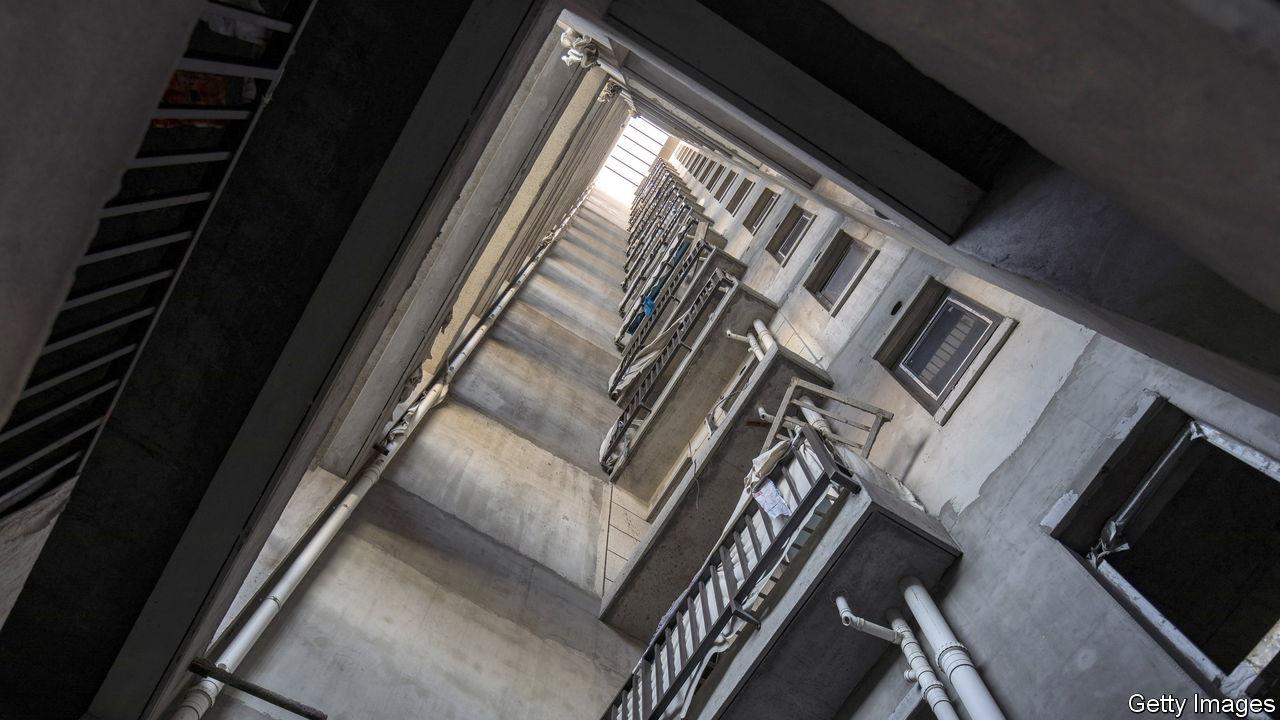
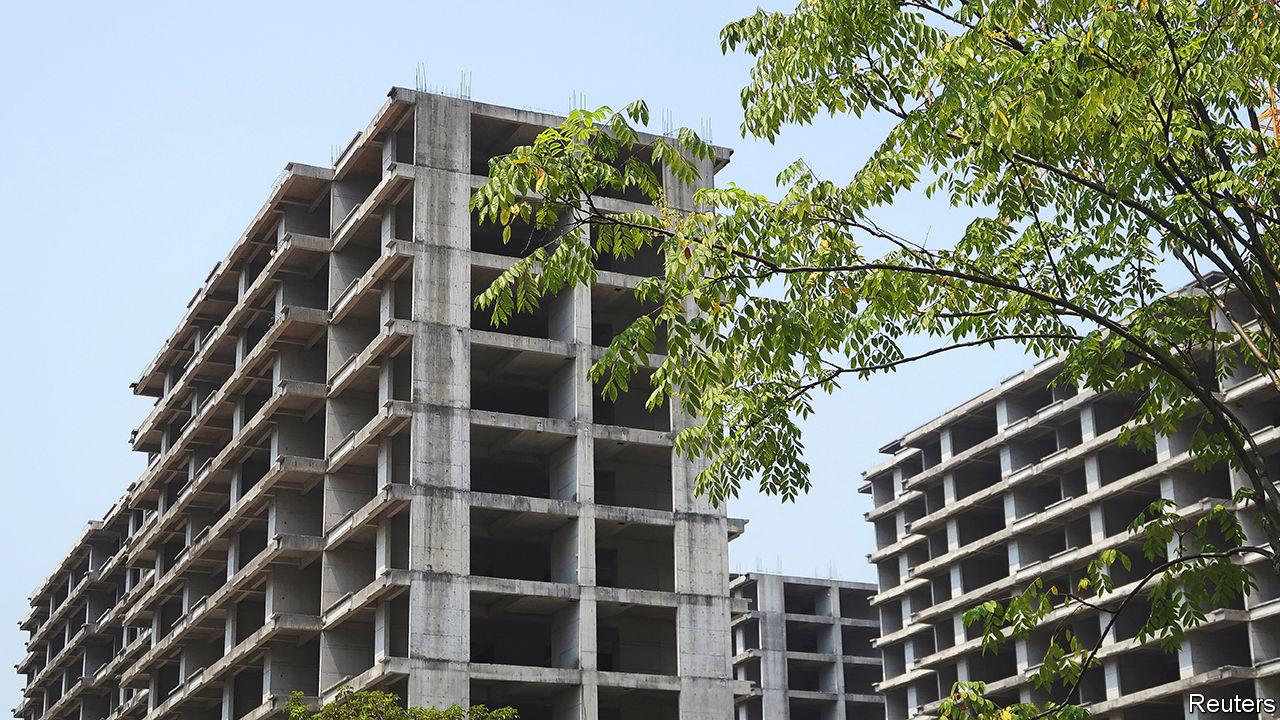
TO JUDGE BY the high-rises dotted along the shore in Haiyang, a small coastal city, Country Garden’s prospects are pretty meagre. The firm, China’s biggest developer by sales, has sold few beachside flats. A handful of towers appear only partly built. A faux-German village with pointed roofs accommodates shops and restaurants, and adds a measure of flair. But it, too, is nearly empty. The company’s failure to sell homes was made clear when its profits for the first half of 2022 nearly evaporated altogether.

Country Garden is not the only Chinese developer to have faced such difficulties. The volume of floor space sold across the country fell by 24% in 2022, the biggest slump since data became available in 1992. Meanwhile, property investment was down 10% year on year, the first drop on record. Cross-border defaults are also proving difficult. Evergrande, the world’s most indebted developer, which collapsed in 2021, has still not produced a restructuring plan originally due in July. The firm’s auditor, PwC, resigned on January 16th. This reduction in activity has been catastrophic for China’s economy, which derives around a fifth of its GDP from property.

The country’s officials are currently redesigning policy on a vast scale. The government has abandoned its “zero-covid” approach to the pandemic, while simultaneously signalling an end to a crackdown on technology firms. Policymakers are also trying to rescue the property industry. After two years of forcing developers to deleverage—which has pushed dozens to default on debts—regulators are now abandoning many of these measures in the hope of reviving sentiment. This has prompted a measure of optimism. Despite the bleak view in Haiyang, Country Garden’s share price has trebled since October.

The exact contents of the government’s reforms remain murky. On January 13th officials produced a draft 21-point plan which stated that the aim was to provide liquidity to “good-quality” developers. The task now is to differentiate between these companies and bad ones: no clear definition has been given of what constitutes good quality. The plan will also push policy banks to grant loans for stalled projects and state-owned asset managers to provide credit for mergers and acquisitions. Commercial banks, which had pulled back from property, have been told to start lending to reliable developers once again. And state media report that the “three-red-lines” policy, which capped debt, will be relaxed for 30 unnamed firms.

Companies began rapidly raising new debt in December—a sign that policy easing kicked off well before the government announced the new measures. Local authorities have been lowering mortgage rates, and many are now at record lows. The state’s bail-out funds are targeting unfinished construction. About 60% of homes sold between 2013 and 2020 are thought not to have been delivered to buyers, many of whom have nevertheless started to make payments. Without funding, construction projects have stalled and cannot be finished. Fear of unfinished homes has put off prospective buyers.

The state also wants to avoid more messy defaults. Country Garden made a last-minute payment to bondholders on January 17th. This was enabled by support from local governments, something few companies aside from those as big and important as Country Garden have at the moment. According to Refinitiv, a data firm, some 950bn yuan ($140bn) in offshore dollar debts alone will mature this year, up from 810bn yuan last year.
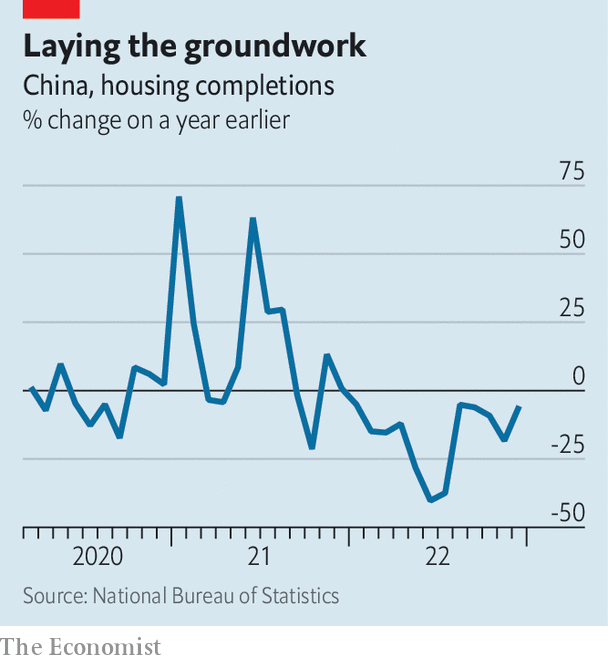
The plan is showing some early results. Home completions fell by 6% year on year in December, marking a recovery from the month before when they fell by 18% (see chart). This is a closely watched measure: unfinished homes prompted homebuyers to boycott their mortgage payments last year, as part of a wave of protests. The reforms have been assisted by the removal of covid-19 restrictions. A few weeks before the policy changes, moving about in Chinese cities (say, to look at a property) carried the threat of quarantine. Preliminary data from Beike Research Institute, a consultancy, suggest that sales of existing homes in 50 big Chinese cities may have risen by more than a fifth in the first ten days of the year, compared with the same period a month earlier.

Kaisa, a developer that defaulted in 2021, has been avoiding restructuring talks with foreign investors and looks to be far from an agreement with creditors. Yet despite its troubles, demand for the company’s homes appears to be growing. Analysts from CreditSights, a research firm, recently visited a project in Shanghai and found agents were no longer offering discounts on flats. The absence of price cuts suggests demand is beginning to pick up for properties in good locations.

A few foreign investors have been encouraged by the state’s plan. Firms have almost entirely been shut out from the offshore bond market, where many global asset managers and hedge funds are trying to recoup losses following missed payments. The funds raised by developers fell by a quarter last year compared with the year before. But on January 12th Dalian Wanda Commercial Management priced a $400m junk bond, the first in more than a year and a sign that some well-known developer-linked groups may slowly return to the offshore dollar-bond market in the coming year. Fidelity and BlackRock, two American asset managers, bought into the offering, according to Reorg, a research house.

Time for the tightrope
The reforms could bring about a stabilisation of the housing market and a slight rebound in sales in the second quarter of the year, according to analysts at Morgan Stanley, a bank—roughly what the government is hoping to achieve. But officials must tread a fine line. Too much funding would revive old problems of oversupply, and do so at a time when China’s population is beginning to decline. Vacancy rates hit 7% in China’s biggest cities last year and 12% in second-tier cities, much higher than the global average, reckons JPMorgan Chase, another bank. About 70% of homes sold since 2018 have been bought by people who already own at least one property.

Speculation has made Chinese homes the most expensive in the world on a price-to-income basis. Hong Hao of GROW Investment, an asset-management firm, says the three-red-lines policy at least obliged developers to slow the rate at which they took on debt. The campaign brought on huge problems for the Chinese economy, but without it “the situation would be much worse”, he adds. If the government ends up pouring too much money into the bail-out it could lead to another wave of excess, and more empty seaside projects. ■
Dare to dream

发表于 2023-03-02 | 分类于 The Economist

How the world economy could avoid recession
Markets are giddy, but there is a long way to go
Jan 24th 2023

LAST YEAR markets had a terrible time. So far 2023 looks different. Many indices, including the Euro Stoxx 600, Hong Kong’s Hang Seng and a broad measure of emerging-market share prices, have seen their best start to the year in decades. America’s S&P 500 is up by 5%. Since reaching its peak in October, the trade-weighted value of the dollar has fallen by 7%, a sign that fear about the global economy is ebbing. Even bitcoin has had a good year. Not long ago it felt as though a global recession was nailed on. Now optimism is re-emerging.

“Hello lower gas prices, bye-bye recession,” cheered analysts at JPMorgan Chase, a bank, on January 18th, in a report on the euro zone. Nomura, a Japanese lender, has revised its forecast of Britain’s recession “to something less pernicious [than] what we originally expected”. Citigroup, another bank, said that “the probability of a full-blown global recession, in which growth in many countries turns down in tandem, is now roughly 30%, [in contrast with] the 50% assessment that we maintained through the second half of last year.” These are crumbs: the world economy is weaker than at any point since the lockdowns of 2020. But investors will eat anything.

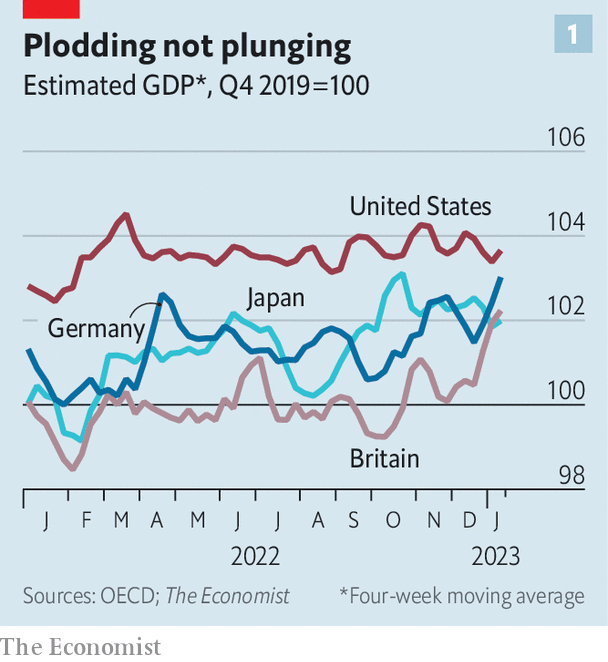
Forecasters are in part responding to real-time economic data. Despite talk of a global recession since at least last February, when Russia invaded Ukraine, these have held up better than expected. Consider a weekly estimate of GDP from the OECD, a group of mostly rich countries which account for about 60% of global output. It is hardly booming, but in mid-January few countries were struggling (see chart 1). Widely watched “purchasing-manager index” measures of global output rose slightly in January, consistent with GDP growth of about 2%.

Official numbers remain mixed. Recent figures on American retail and industry came in below expectations. In Japan machinery orders were far weaker than forecast. Yet after reaching an all-time low in the summer, consumer confidence across the OECD has risen. Shortly after we went to press, officials were due to publish their first estimate of America’s GDP in the fourth quarter of 2022. Most economists were expecting a decent number, though pandemic disruptions mean these figures will be less reliable than normal.

Labour markets seem to be holding up, too. In some rich countries, including Austria and Denmark, joblessness is rising—a telltale sign that a recession is looming. Barely a day goes by without an announcement from another big technology company that it is letting people go. Yet tech accounts for a small share of overall jobs, and in most countries unemployment remains low. Happily, in places where demand for labour is dropping, employers are withdrawing job adverts, rather than sacking people. We estimate that, since reaching an all-time high of more than 30m early last year, unfilled vacancies across the OECD have fallen by about 10%. Meanwhile, the number of people actually in a job has fallen by less than 1% from its peak.

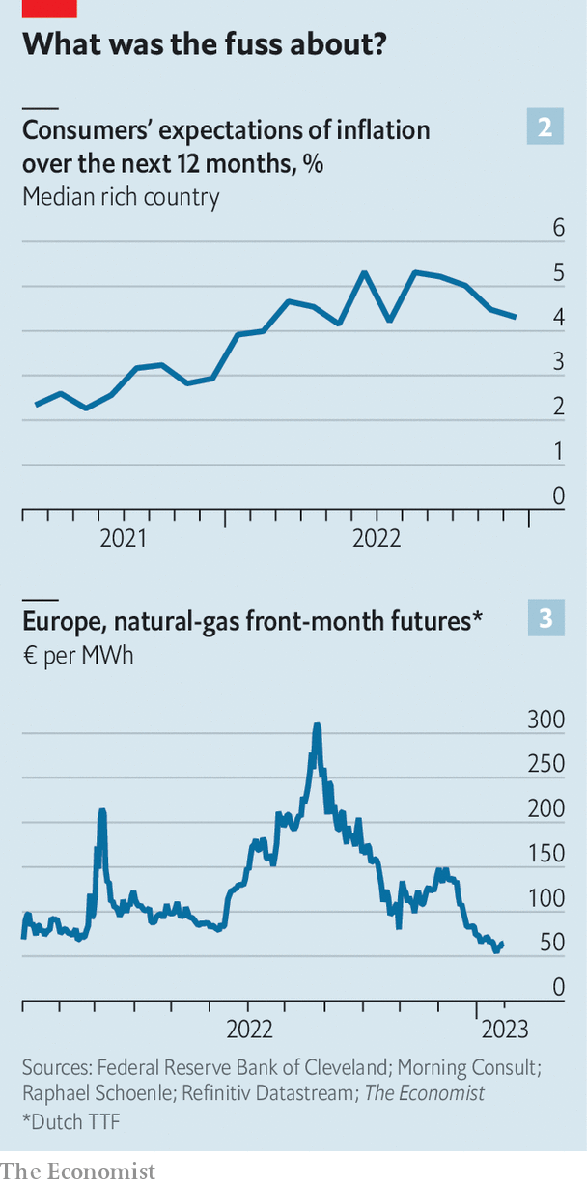
Investors pay attention to labour markets, but they really care about right now is inflation. It is too soon to know if this threat has passed. In the rich world “core” inflation, a measure of underlying pressure, is still 5-6% year on year, far higher than central banks find comfortable. The problem, though, is no longer getting worse. In America core inflation is coming down, as is the share of small firms which plan to raise prices. Another measure, from researchers at the Federal Reserve Bank of Cleveland, Morning Consult, a data firm, and Raphael Schoenle of Brandeis University, is a cross-country gauge of public inflation expectations. It also seems to be dropping (see chart 2).

Two factors explain why the global economy has held up better than expected: energy prices and private-sector finances. Last year the cost of fuel in the rich world rose by well over 20%—and by 60% or more in parts of Europe. Economists expected prices to remain high in 2023, crushing energy-intensive sectors such as heavy industry. They were wrong. Helped by unseasonably warm weather, companies have proved unexpectedly flexible when it comes to dealing with high costs. In November German industrial gas consumption was 27% lower than normal, yet industrial production was only 0.5% down on the year before. And over the Christmas period European natural-gas prices fell by half to levels last seen before Russia invaded Ukraine (see chart 3).

The strength of private-sector finances has also made a difference. Our best guess is that families in the G7 are sitting on “excess” savings—ie, those above and beyond what you would expect them to have accumulated in normal times—of around $3trn (or about 10% of annual consumer spending), accumulated through a combination of pandemic stimulus and lower outlays in 2020-21. As a result, although companies’ quarterly earnings in America suggest spending is faltering, it is not falling off a cliff. Consumers can weather higher prices and a higher cost of credit. Businesses, meanwhile, are still sitting on large cash piles. And few face large debt repayments right now: $600bn of dollar-denominated corporate debt will mature this year, compared with $900bn due in 2025.

Can the data continue to beat expectations? There is evidence, including in a recent paper by Goldman Sachs, a bank, that the heaviest drag from tighter monetary policy occurs after about nine months. Financial conditions started really tightening nine months ago. If the theory holds, then the economy soon might be on surer footing, even as higher rates eat away at inflation. China is another reason for cheer. Although removing domestic covid-19 restrictions slowed the economy in December, as people hid from the virus, scrapping “zero-covid” will ultimately raise global demand for goods and services.

The pessimistic case, however, remains strong. Central banks have a long way to go before they can be certain that inflation is under control, especially with China’s reopening pushing up commodity prices. America’s forward-looking indicators are getting bleaker. In addition, an economy on the cusp of recession is unpredictable. Once people start to lose jobs, and cut spending, predicting the depths of a downturn becomes hard. And a crucial lesson from recent years is that if something can go wrong, it often does. But it is nice to have a glimmer of hope all the same. ■

Eating to 100

发表于 2023-03-02 | 分类于 The Economist

America has healthy cuisines—if you know where to look
Dan Buettner’s book explores America’s healthiest cuisines
Jan 25th 2023

NEARLY 70% of American adults are overweight; over a third are obese. Grocery shops contain aisle after aisle of salty crisps, sugary drinks and processed snacks. Cues to eat unhealthily abound. But if this is your archetypal American diet, argues Dan Buettner in “The Blue Zones American Kitchen”, a work of anthropological reporting posing as a cookbook, you are looking in the wrong places.

Mr Buettner studies and writes about “Blue Zones”, areas where people tend to live long, healthy lives, with unusually high numbers of centenarians and long life expectancy in middle age. In this book, he finds the principles of Blue Zone diets—very little meat and processed foods, with most calories coming from whole grains, greens, tubers, nuts and beans—in the cuisines of four demographic groups: Native Americans, African-Americans, Latinos and Asian-Americans.

The recipes that Mr Buettner presents do not necessarily represent what most people in these groups actually eat. For a variety of reasons, for instance, Native Americans and Latinos suffer higher obesity rates than non-Hispanic whites—which would probably not be the case if they all ate as this book recommends. But, historically, each of these groups had healthy cuisines, and Mr Buettner talks to people trying to revive them.

African-American cuisine is often unfairly maligned for over-relying on fried and processed foods. Mr Buettner says this aspect of it is an artefact of the Great Migration, when black people left bountiful gardens in the South, which provided greens, beans and root vegetables, for industrial northern cities. And so the recipes in this part of the book feature crops such as okra, collard greens and Carolina Gold rice, a delicious west African strain. All these played crucial roles in African-American diets for centuries.

Diverse as the recipes collected here are, most rely on seasonal, fresh produce, often home-grown. Mr Buettner recounts his confusion when following his GPS directions to meet a Hmong woman in her garden, and ending up in the car park of Target, a department store. Behind a row of trees, he found a five-acre garden bought by Hmong refugees in the 1970s that, he says, “looked like Cambodia in the morning, [with] fields of bitter melon and zucchini, and people walking around with wicker baskets.”

He says the encounter left him convinced that “there’s so much culinary genius in America that also lines up perfectly with the dietary patterns that produced the longest-lived humans in history. It’s so easy if you look for it.” The truth is a bit more complicated. For urbanites without a garden, these recipes may prove expensive and time-consuming. And as Mr Buettner’s other work on Blue Zones attests, food is just one part of the longevity puzzle. Centenarians tend to live active, purposeful lives centred on family and community.

So this book is not a shortcut to a 100th birthday. But anyone who wants a shot at a century should probably eat less meat and munch more legumes and whole grains. ■

A long goodbye

发表于 2023-03-02 | 分类于 The Economist

In the struggle to give up fossil fuels, is innovation a necessity or a distraction?
How much innovation is necessary to see off fossil fuels?
Mark Jacobson contributes to an urgent debate in “No Miracles Needed”
Jan 25th 2023

No Miracles Needed. By Mark Jacobson. Cambridge University Press; 400 pages; $14.99 and £11.99

“THE STONE AGE did not end for lack of stone, and the Oil Age will end long before the world runs out of oil.” That sounds like the oath of environmentalists opposed to the use of fossil fuels. In fact, the prediction was made by Sheikh Zaki Yamani, a Saudi Arabian oil minister who shot to prominence as the face of the Arab oil embargo of 1973. He was convinced that innovations in alternative energy sources and fuels would ultimately loosen oil’s grip on the global economy.

It has not happened yet. This year marks the 50th anniversary of the first oil shock. Far from innovating its way to a clean-energy future, the world slipped into complacency as the disruptions of the 1970s faded from memory. Oil, coal and natural gas still make up over four-fifths of the world’s primary energy supply. That addiction—plus a concatenation of war, policy mistakes and economic trends—has now inflicted another energy crunch on the world. Will this squeeze also be forgotten, or could it lead to an overdue revolution in energy?

There are two reasons to think change is coming. The first force is familiar: geopolitics. Five decades ago, it was the oiligopolists of the OPEC cartel who clumsily manipulated energy markets. This time Russia, an oil-and-gas powerhouse, has provided an ugly reminder of the dangers of relying on nasty authoritarian regimes. The second factor is rising anxiety about climate change. To avoid its worst effects, almost 200 countries have agreed to restrain emissions of greenhouse gases (GHGs); many are already moving towards a decarbonised energy system. Those twin forces have redoubled efforts to phase out fossil fuels.

Responding to cuts in gas supplies from Russia, the European Commission has put in place aggressive policies to ramp up home-grown renewable alternatives, including electricity from wind power and green hydrogen. The International Energy Agency (IEA), an official forecaster, predicts that full implementation of existing policies alone will lead to peaks in global consumption of coal and gas by 2030 and of oil by the mid-2030s. The hard question is what happens after that. Will innovation end the Oil Age, as Yamani predicted?

That hope is championed by a camp of thinkers which includes Bill Gates, the co-founder of Microsoft. In an influential recent book, Mr Gates argued that the pressing need to decarbonise the global economy requires big bets on a variety of nascent but promising technologies, ranging from advanced nuclear energy to “direct air capture” of GHGs. He warned against placing too much faith in wind and solar power, highlighting the constraints imposed by their intermittent generation.

Investing in potential breakthroughs may seem uncontroversial. John Kerry, America’s special presidential envoy for climate change, discovered it is not. In the run-up to a UN climate summit in Glasgow in 2021, he pointed to scientific assessments suggesting that perhaps half of GHG reductions needed by the middle of this century will “come from technologies we don’t yet have”. Mr Kerry was denounced by those who saw that as an attack on existing technologies. Michael Mann, a climate scientist, dismissed his comment as “pernicious technophilia”. Greta Thunberg, an activist, declared: “Great news! I spoke with Harry Potter and he said he will team up with Gandalf, Sherlock Holmes and the Avengers and get started right away!”

Blow, winds, and crack your cheeks
Now Mark Jacobson, an influential engineering professor at Stanford University—whose research was the basis of the policy approach known as “the Green New Deal”—is furthering the debate. In “No Miracles Needed” he says the world must urgently tackle the related scourges of global warming, energy insecurity and local air pollution. This, he insists, will require no “miracle technologies”. On the contrary, “we have 95% of the technologies that we need already commercially available. We also know how to build the rest.” The heart of his plan is a dramatic expansion of wind and solar power (alongside some hydro- and geothermal energy) and, relatedly, of energy storage and transmission.

At first blush, that sounds plausible. Wind and solar are not only commercially viable and operating at scale around the world; they are the cheapest forms of new power generation in most countries. Renewable capacity is set to grow by 2,400GW from 2022 to 2027, equal to the entire power capacity in China today.

Meanwhile, the technologies involved in power transmission are so well-established that America’s National Academy of Engineering hailed grid electrification as the greatest engineering feat of the 20th century. And though energy storage is not yet ubiquitous and affordable, large battery-based systems are operating successfully on grids from California to Australia.

Professor Jacobson’s scholarly and analytical book is persuasive in other ways, too. In common with Mr Gates, he believes everything that can reasonably be electrified should be. He rightly denounces the inefficiency of internal-combustion engines and other fossil-burning generators in comparison with electric alternatives. He acknowledges that long-distance transport and certain industrial applications will require fuels such as hydrogen, rather than electricity, if they are to be decarbonised. And he cleverly rebuts concerns about the variability of wind and solar generation: big power plants, he notes, are themselves often unavailable owing to scheduled maintenance and outages. Much of France’s nuclear fleet has recently been offline, wreaking havoc on its grid.

But there are two wrinkles in his argument. One is overreach. Other proponents of rapid decarbonisation advocate using renewables for the great majority of power within a couple of decades. Professor Jacobson wants them to cover a full 100% by 2035. “Did Magellan aspire to circumnavigate 99% of his way around the Earth?”

Yet a big study by America’s Department of Energy in 2021 found that, though getting close to 100% could be cost-effective, the final few percent would be disproportionately pricey. A dash to supersize what are still smallish industries could stumble on bunged-up supply chains and shortages of talent. Other obstacles liable to raise costs and cause delays include NIMBYism and regulatory backlogs. In America proposed solar projects dawdle in queues for interconnection for more than twice as long as in 2005. In each of Germany, Italy, Poland and Spain, over eight times as much wind capacity is waiting for permits as is under construction. Professor Jacobson acknowledges these problems but has no convincing answers to them.

The second flaw in his case is that, by forswearing technological “miracles”, it is needlessly dismissive of potential game-changers such as nuclear fusion, a risky but alluring long-term bet that has recently attracted billions of dollars in private investment. The UN’s authoritative Intergovernmental Panel on Climate Change keeps the door open to various technologies for carbon-dioxide removal (CDR), from direct air capture of GHGs with giant machines to the use of carbon capture and sequestration in the generation of bioenergy. The author wants to rule out such kit, in part because he thinks it is less green than wind or solar and “diverts funding from lower-cost renewables”.

That is a false economy. The IEA, which is firmly with Professor Jacobson in calling for a peak in fossil consumption, nevertheless insists getting to net-zero GHG emissions by 2050—a goal adopted by many countries—requires “massive leaps in innovation” in advanced batteries, hydrogen, synthetic fuels, carbon capture and other technologies that are not yet commercial. “This is a Herculean task,” Fatih Birol, the agency’s boss, has said. Pressing on without investing in breakthrough innovation would make it even harder. ■

The other brain cells

发表于 2023-03-02 | 分类于 The Economist

Neurons are not the only brain cells that think
Astrocytes, for instance, may play a role in depression and anxiety
Jan 23rd 2023

MOST PEOPLE, if they think about the matter at all, probably think of thinking as something done by the huge network of specialised, electrically conductive cells called neurons that occupies the upper half of their skulls. And, as far as it goes, that is true. The 86bn neurons in a human brain do indeed do much of the cognitive heavy lifting. But not all of it.

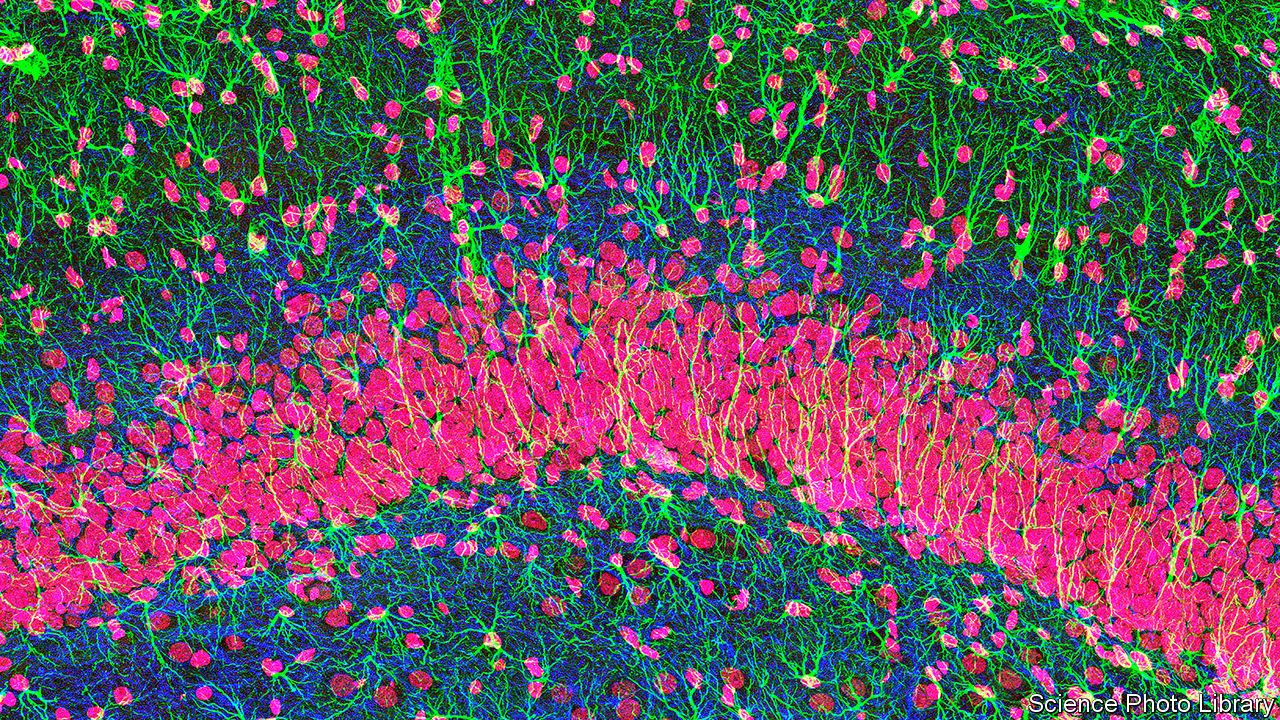
Supporting them is a cast of three other varieties of brain cell—microglia, oligodendrocytes and astrocytes—collectively called glial cells (short for “neuroglia”, from the Greek for “nerve glue”). Until recently, these were neglected by neurology. That has changed. Glial cells (their filaments stained green in the section of rat hippocampus pictured, with neuron filaments stained blue and the nuclei of both stained red) are now fashionable topics of study. The results have blown away the idea that they are mere glue.

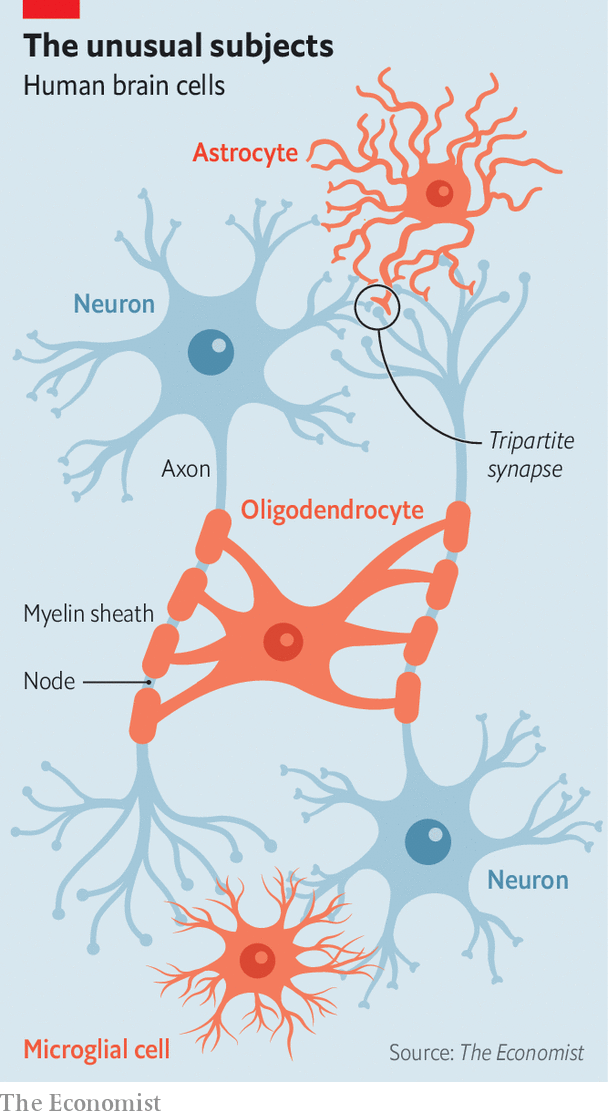
Microglia are gardeners. They prune links between neurons to keep the network in order. Oligodendrocytes, long dismissed as mere insulators of the electrically conductive fibres called axons via which neurons communicate, have crucial roles in tweaking axonic signals. And astrocytes, the most interesting of the lot, turn synapses—the junctions where axons meet and transfer signals—into the biological equivalents of transistors, by regulating the flow of information passing through them.

Out of ‘cyte, out of mind
Nor are these results of merely academic interest. Misbehaving glial cells are now implicated in a range of conditions, from autism to multiple sclerosis to obsessive-compulsive disorder. Their study thus has important medical applications. They are also of concern to those who design the brain-simulacra called artificial neural networks, on which machine learning and artificial intelligence depend. So, while it remains true that neurons are the stars of the cranial theatre, the other actors’ roles are being rapidly elucidated. And, with that, the play’s plot is thickening.

For microglia, the crucial paper was published in 2012. In it Dorothy Schafer of Harvard Medical School and her colleagues showed that these cells prune synapses during brain development, and that this is a process which continues into a person’s mid-20s. Beforehand, microglia had been viewed merely as parts of the immune system, important for mopping up pathogens and cellular debris, but basically Cinderellas. Dr Schafer turned them into belles of the ball. She found that, by hunting down and swallowing rarely used synapses, microglia keep the brain lean and mean, streamlining the computations neurons perform and ensuring the organ remains as efficient as possible.

The revelatory moment for oligodendrocytes came two years later, in 2014. Hitherto, their role, though well known, had also seemed humdrum. Oligodendrocytes produce myelin, a mixture of proteins and lipids which they wrap around axons, in outgrowths called sheaths, to improve those fibres’ electrical conductivity. In that year, though, a team led by Armin Seidl of the University of Washington, in Seattle, discovered that oligodendrocytes use myelin to fine-tune the velocity of electric signals in axons.

For example, axons carrying signals from the left and right ears to a particular part of the auditory cortex will differ in length, so those signals might be expected to take different amounts of time to arrive. Oligodendrocyte fine-tuning (achieved by adjusting the diameter of the axon and of the distances between the nodes of the myelin sheath) compensates for this, meaning any remaining difference reflects the actual interval between the times of a sound’s arrival at each ear. And it is that real difference which the brain uses to locate whence a sound has come.

It is the newly discovered abilities of astrocytes, however, that are really exciting researchers. These snowflake-shaped cells sport tendrils, each terminating in an appendage called an “end-foot”. Every astrocyte governs a territory of its own, and these tessellate to form a three-dimensional mosaic across the brain.

Playing footsie
End-feet hunt down and envelop synapses, allowing astrocytes to eavesdrop on the chatter between neurons and then, by strengthening or weakening particular synapses, exert control over the computation done within networks of neurons. Consequently, there is now compelling evidence that astrocytes play a crucial role in memory formation, especially in the hippocampus, which consolidates relevant short-term memories into long-term ones.

Biopsies suggest that (depending on the brain region) astrocytes regulate between 50% and 90% of human-brain synapses in this way. Astrocytes’ meddling is thus the rule, not the exception. Many researchers now talk of “tripartite” synapses as being standard in the brain. Their transistor-like three-element composition has one part (the astrocyte) which acts like a transistor’s “base” connection, regulating the passage of signals between the other two (the neurons, the equivalents of a transistor’s “emitter” and “collector”). Since transistors form the logic gates of computers, that is intriguing.

Moreover, astrocytes do not just meddle in the business of neurons. They also seem able to perform computations of their own. Where two astrocytes’ territories meet, their tendrils can connect, letting them form networks like those of neurons. This permits them to communicate using pulses of calcium ions passed from the tendril of one cell to that of another.

Early in 2021 a team of researchers from Tampere University in Finland, led by Michael Barros, used gene-edited astrocytes to show that these calcium-ion signals can perform Boolean algebra, the language of digital computing. In particular, the team were able to run Boolean operations called AND and OR with a rate of accuracy of up to 90%. In 2022 Erik Peterson of Carnegie Mellon University, in Pittsburgh, published a mathematical proof showing that, in principle, an astrocyte network can run any computer algorithm imaginable. This hints astrocytes may form a secondary computational network, parallel to that of neurons, which is able to regulate the primary network via tripartite synapses.

The emerging picture of the brain, then, is less an aristocracy—with neurons looking down on their glial inferiors—than a democratic society of cells working together to produce thoughts. In 2022 Alexey Semyanov and Alexei Verkhratsky of the Russian Academy of Sciences dubbed this idea the “active milieu” within the brain.

One consequence of the active milieu interpretation is a realisation that when glia misbehave there is trouble. A large body of evidence now suggests that dysfunctional glia play an important role in many neurological and psychiatric conditions.

Autism is one. In 2017 Ishizuka Kanako of the Nagoya Institute of Technology, in Japan, found a link between an increased risk of autism and the presence of a pair of genetic variants known to disrupt, in microglia, the expression of a protein called CX3CR1. And in 2020 Xu Zhixiang of Scripps Research, in San Diego, showed a range of microglial protein-synthesis problems cause autism-like symptoms in mice.

Current thinking is that misfiring microglia in people with autism fail to prune synapses thoroughly enough during brain development, resulting in overconnected brains with heightened sensitivity to stimuli, both sensory and emotional. Moreover, the effect that Dr Xu found disproportionately affects male mice—a bias that, perhaps not coincidentally, is also a feature of autism in human beings.

In the past decade, meanwhile, several lines of evidence, including brain-imaging, post-mortem and genetic studies, have pointed to dysfunctional oligodendrocytes as the cause of psychosis in conditions like multiple sclerosis, bipolar disorder and schizophrenia. Such dysfunction disturbs the myelin on axons, disrupting the timing of their signals. The hypothesis is that this results in the hallucinations—imaginary sights and sounds—that are the defining feature of psychosis.

There is also compelling evidence that misfunctioning astrocytes play a role in mood disorders such as depression and anxiety, and in neurodegenerative diseases like Alzheimer’s. Most strikingly, in 2021 Liam O’Leary at McGill University in Montreal reported that the brains of depressed suicide victims had markedly reduced densities of astrocytes, compared with healthy brains, in parts of the prefrontal cortex (the brain’s executive), the caudate nucleus (which helps control goal-directed behaviour) and the thalamus (which passes sensory information to the cortex).

And it is not only psychiatrists who are inspired by the newly discovered roles of glia. Computer scientists are getting in on the act, too. Artificial neural networks are based on an early model of how neurons work—and, though subsequent investigation has shown this was simplistic, these networks’ organisation into interconnected layers of neuron analogues does reflect that of the cerebral cortex. Understandably, therefore, some computer scientists have tried adding artificial glia to networks to see if their performance improves.

Transistorised, at half the price
It does. Several groups have discovered independently that getting rid of rarely used synapses, the job of microglia, helps artificial neural networks to encode new information and store memories. Coming up with ways to make neural networks sparser is now an important field.

Artificial astrocytes are also being investigated, along with the idea of artificial neuron-glia networks (ANGNs). These imitate tripartite synapses by using astrocyte analogues to strengthen and weaken synapses in response to how the rate at which those synapses fire changes over the course of time. When tested alongside conventional networks, ANGNs consistently outperform them. As with many things in human engineering, it seems that nature got there first. ■

Can it deliver again?

发表于 2023-03-02 | 分类于 The Economist

Can Amazon deliver again?
The pioneering e-commerce giant battles soaring costs and a stagnating legacy business
Jan 26th 2023 | Seattle

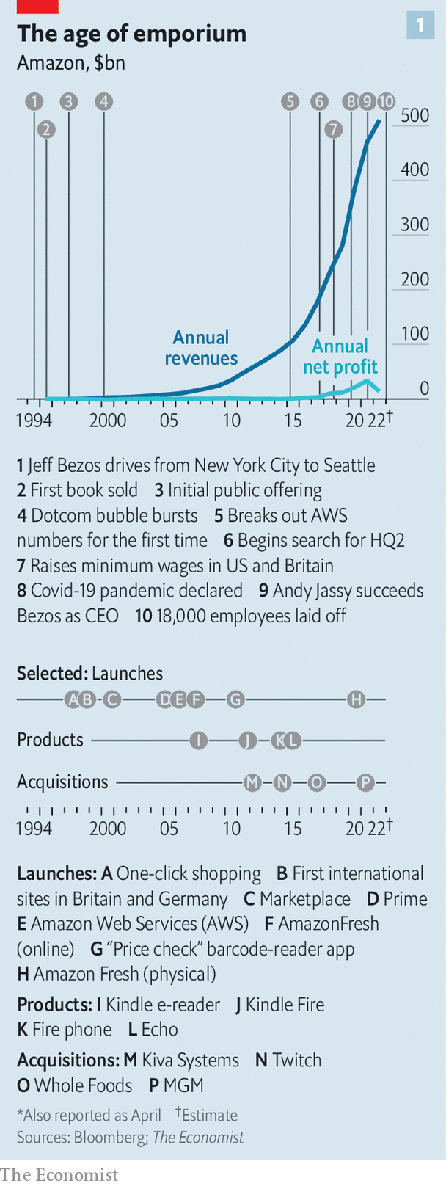
IT IS HARD not to be in awe of Amazon. It is one of history’s greatest companies. Jeff Bezos nurtured the firm from the humble online bookshop he founded in 1994 into a tech juggernaut, selling everything from corn syrup to cloud computing, a future trillion-dollar industry that Amazon more or less invented (see chart 1). Today it is the world’s fifth-most-valuable company, third-largest revenue generator and second-biggest private employer. Its warehouses, data centres, shops and offices cover an area almost the size of Manhattan. Consumers, competitors and politicians have been left to wonder if Amazon would take over the world. Or whether it would stop there—it is investing heavily in Kuiper, a satellite-broadband venture.

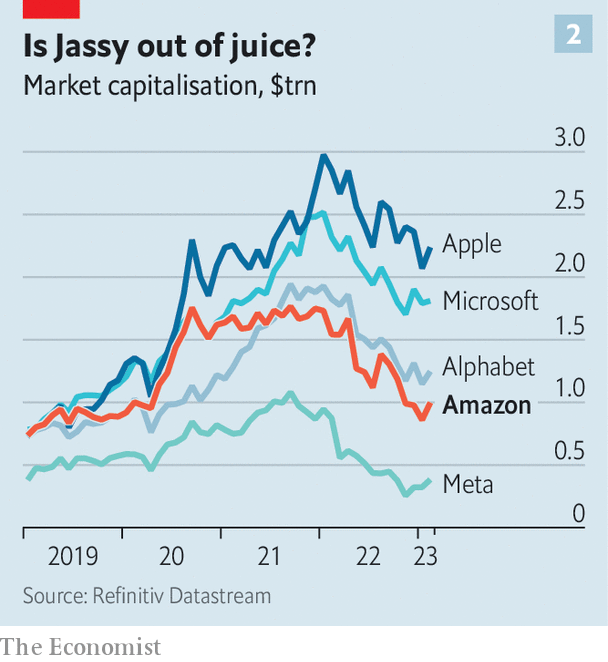
All the superlatives notwithstanding, it is equally hard not to recognise that Amazon finds itself in something of a funk. With a downturn on the cards in America, its biggest market, shoppers are tightening their purse strings and corporate IT departments are paring back cloud spending. Amazon’s market value is down by around $1trn since its peak in mid-2021 (see chart 2), erasing all the gains of the covid-19 pandemic, when customers rushed to join its Prime subscription service and businesses were shifting their data to its cloud division, Amazon Web Services (AWS). This month Amazon announced 18,000 white-collar lay-offs, amounting to 6% of its corporate workforce. When it reports fourth-quarter earnings on February 2nd its annual revenue growth may for the first time ever come in at single digits, down from 22% in 2021. In October the company warned it might make little or no profit in the last three months of 2022.

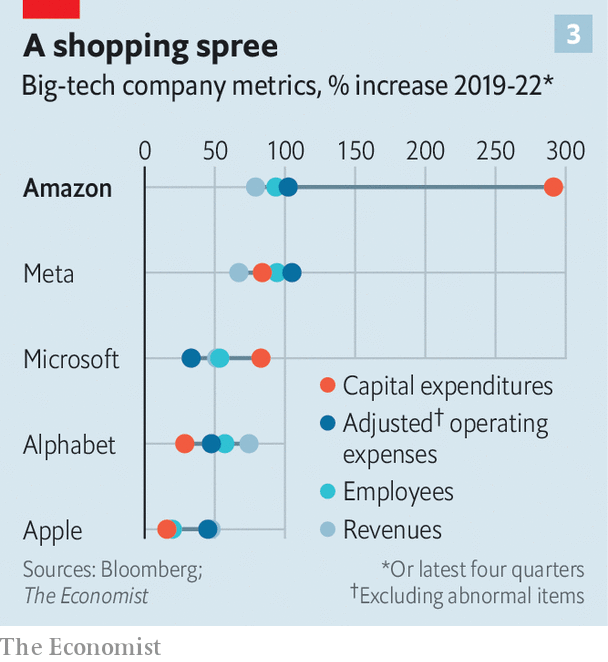
Amazon’s Icarus moment is not unique in big tech. All its fellow tech high-fliers have been hit as demand for their digital wares declines now that people are no longer locked down at home and postmen no longer bring pandemic-stimulus cheques from the government. But under Andy Jassy, the AWS chief who took over as CEO after Mr Bezos retired in July 2021, Amazon has expanded much more aggressively than Alphabet, Apple, Meta and Microsoft (see chart 3). This exuberance leaves the company in a tough spot as it contends with three big challenges: a sputtering retail business; decelerating cash engines of AWS and a newish advertising business; and growing competition. Can the understated Mr Jassy overcome them, and turn Amazon’s sprawling empire into a dependably profitable business?

To understand how Amazon found itself in its current predicament, go back to just before the pandemic. The firm was already planning a big expansion of its warehouse and logistics network. The aim was to offer one-day delivery for more products to more Prime members. When national lockdowns created a boom in online shopping, Amazon doubled down. In April 2020 Mr Bezos told investors: “If you’re a shareowner in Amazon, you may want to take a seat, because we’re not thinking small.”

Over the next two years Amazon doubled the size of its fulfilment network. Mark Mahaney of Evercore ISI, an advisory firm, calculates that Amazon added about 130m square feet (12m square metres, or nearly four Central Parks) to its global footprint in both 2020 and 2021. In those years Amazon’s cumulative capital spending reached $100bn. No company anywhere in the world invested more in that period. Last year it may have invested another $60bn, again more than anyone else. Around half that sum went on warehouses and vehicles; most of the rest on AWS data centres. Amazon also increased its payroll to 1.6m, from 800,000 in 2019.

In the first quarter of 2022 Amazon admitted that overhiring and overbuilding were each adding $2bn to its quarterly costs, relative to 2021. Pricier fuel and higher wages meant a further $2bn a quarter. In April 2022 workers at a warehouse on Staten Island voted to unionise, and called for “more reasonable” productivity targets and more pay. If Amazon agrees to the union’s demands, the Staten Island warehouse alone could add $200m or so to annual operating costs, estimates Morgan Stanley, a bank. At the same time, retail sales slowed; in December American consumers spent 1.1% less than the month before. Amazon’s retail losses are thus piling up. Mike Morton of SVB MoffettNathanson, a research firm, estimates that when you strip out profits from ads, annual operating losses from the retail division (plus devices, entertainment and other smaller units) amount to about $30bn.

The ad operation itself is another point of concern. In the past few years it has gone from virtually non-existent to the world’s fourth-biggest, with yearly revenues of $36bn. Its operating margins are reckoned to be around 30%, on a par with the industry’s two giants, Alphabet and Meta. But profitability may be slipping. Amazon has reportedly splurged around $1bn for the rights to stream some American-football matches, and alongside them some ads—a fortune compared with the cost of posting banners on its own website. At the same time, year-on-year growth in ad sales has slowed sharply, to 25% in the third quarter of 2022, from 53% the year before.

Amazon’s main cash engine, AWS, is also decelerating as business customers trim their digital budgets. Soaring energy prices, especially in Europe, made it much costlier to keep the power-hungry data centres whirring. What is more, AWS is particularly vulnerable to shrivelling orders from startups, which tend to favour it over rivals such as Microsoft Azure. As their venture-capitalist backers grow stingier amid the tech rout, the young tech firms are slashing their cloud spending. In October Brian Olsavsky, Amazon’s chief financial officer, admitted that AWS’s annual sales growth had declined to around 25%, the slowest on record. The average remaining lifetime of AWS contracts also ticked down in the most recent quarter, suggesting that customers are signing fewer deals or shorter ones. Microsoft, the second-biggest cloud provider, said on January 24th that it expects sales growth at its cloud unit to decelerate by four or five percentage points this quarter.

Another problem is stiffening competition. As covid pushed shoppers online, traditional retailers switched their focus to e-commerce. Walmart increased its last-mile-delivery capacity four-fold just since the start of 2022. Target, another legacy supermarket chain, has used its acquisition in 2017 of Shipt, an online-shopping platform, to spruce up its digital-sales channels. Between 2018 and 2021 six big conventional retailers, including Walmart and Target, increased their collective share of American e-commerce spending from 8% to 12%, according to SVB MoffettNathanson. In the same period Shopify, a Canadian firm which offers merchants tools to sell online, expanded its market share in America from 5% to 10%. It is investing heavily in its own fulfilment service, which it launched in 2019.

Rivals are making their presence felt in Amazon’s non-retail businesses, too. AWS’s healthy first-mover lead in the cloud is being eaten away. Numbers from Synergy Research Group, a data provider, show that its global market share in the business has more or less stabilised at just over 30% in the past three years. Its two main domestic rivals, Microsoft and Alphabet, have more or less drawn level with it when taken together. In advertising, Apple has a small but growing operation and Microsoft is dipping its toe in the water, signing a deal last year to provide adverts for Netflix’s new ad-supported streaming service.

The combination of loss-making retail, slowing profit motors and growing competition is hammering Amazon’s profitability. The firm’s overall operating margin in the third quarter of 2022 was just 2%, the lowest since 2017. In the past four quarters Amazon lost $26bn in free cashflow (the money companies generate after deducting capital investments).

Little of this can be laid directly at Mr Jassy’s door. Mr Bezos’s departure stripped the new boss of some battle-hardened lieutenants. Dave Clark, who ran the retail arm and was seen as another possible successor, left to run Flexport, a supply-chain consultancy. Charlie Bell, a talented AWS executive, jumped ship to Microsoft. Other Bezos-era stalwarts, including Jay Carney, head of public relations and policy, and Jeff Blackburn, head of media, are also moving on. Moreover, the startup-like culture of innovation Mr Bezos cultivated is hard to maintain at Amazon’s staggering size, says one longtime executive.

As for the ambitious expansion plans, they were hatched under Mr Bezos, who remains executive chairman. The soft-spoken Mr Jassy, whom you would be forgiven for not noticing in a moderately crowded room, has said he consults his former boss about once a week. With the possible exception of concentrating the lay-offs in the Echo smart-speaker unit, in which Mr Bezos was deeply involved, it is hard to point to decisions the current CEO has made that Amazon’s founder wouldn’t have.

With Mr Bezos preoccupied with his rocketry firm, Blue Origin, and other plutocratic pursuits, Mr Jassy looks safe in his job for the time being. But he has his work cut out. The first task is to rein in spending and boost returns. It has been a while since Amazon dialled back its capital expenditure, which it does every now and again to show shareholders just how profitable it is, notes Mark Shmulik of Bernstein, a broker.

Now such moves may be in the offing. Last February the price of Prime membership in America rose for the first time, from $119 a year to $139. European Prime members have seen a similar increase. Fees that merchants on Amazon’s marketplace pay for fulfilment grew by more than usual in 2022, and on top of that the company levied additional surcharges for inflation and the holiday shopping season. It is trying to sublet some 30m square feet of unneeded space and has begun offering long-term storage for vendors.

In an effort to contain costs, Mr Jassy is binning plenty of projects. Amazon has cancelled or delayed the construction of dozens of warehouses, and closed dozens of physical shops, including all Amazon Books and 4-star outlets, which sold items that received a rating of four stars or higher online. Amazon Glow, a video-calling device, and Astro 2.0, a home robot, were also killed off. The Echo lay-offs look like an attempt by Mr Jassy to downsize a unit that was reportedly losing around $5bn a year.

One thing Mr Jassy seems loth to do is hive off AWS into a separate company, as some investors have urged. A year ago Daniel Loeb, boss of Third Point, a hedge fund, reportedly told his clients that splitting the cloud business from the retail one could generate $1trn in shareholder value. Some big potential customers, such as Walmart, shun AWS because it is run by a retailing rival. A sale would also placate trustbusters, eager to break up what they perceive as unaccountable tech monopolies.

A spin-off would, however, also sever potentially lucrative links between the cloud and retail arms. For instance, AWS has new artificial-intelligence (AI) tools for advertisers to target shoppers on Amazon’s e-commerce site. The line between the two businesses is blurring, says Adam Epstein, co-president of Perpetua, an ad startup. The retail unit, for its part, has spawned several AWS offerings, such as a supply-chain tool first trialled in Amazon’s grocery business. Mr Shmulik thinks AWS may start selling the clever live-streaming technology it developed to broadcast Thursday Night Football on Prime Video.

Indeed, the future may involve weaving AWS more tightly into other parts of the empire. In time that could turn Amazon from primarily a seller of goods to consumers into a seller of increasingly AI-assisted services to both individuals and businesses. Before the pandemic, the share of Amazon’s sales coming from its main business-facing segments was 31% and high-margin services made up 37% of revenue. Today the figures are 46% and 53%, respectively. The company’s multibillion-dollar bets on Kuiper, the satellite network, and Zoox, a self-driving-car venture, hint that those shares may rise further. So do investments in health care. Last year Amazon bought One Medical, a provider of primary care, and launched Amazon Clinic, which offers virtual consultations for more than 20 ailments. On January 24th it unveiled a drug-subscription service for Prime members.

If Mr Jassy can balance capital discipline with a few focused wagers, Amazon could return to greatness. That would be a less inspiring business tale than Mr Bezos’s pursuit of world domination. But it needn’t be less lucrative. ■

A cuddlier China?

发表于 2023-03-02 | 分类于 The Economist

China is trying to win over Westerners and private firms
But Xi Jinping is unlikely to change
Jan 25th 2023 | DAVOS

LIU HE IS a grey-haired 71-year-old on the verge of retirement from China’s highest level of economic policymaking. He must have many regrets, not least the battering of his country’s economy by a now-abandoned struggle to crush covid-19, and by the disease’s recent rapid spread. But Mr Liu grinned with obvious pride as he recalled how members of the global elite at the World Economic Forum in Davos had responded to his delegation’s upbeat remarks there a few days ago. “All kinds of people said, ‘Hey, China is back again!’” he told a television reporter.

Mr Liu, who is one of China’s four deputy prime ministers and a trusted adviser of China’s leader, Xi Jinping, was being modest. It was he, not others in his entourage, who had stolen the show. Among the assembled business titans his speech on January 17th struck a welcome note given the fragile state of the world economy. “If we work hard enough,” he said, “the Chinese economy will see a significant improvement in 2023.” He pledged “more focus” on supporting private business—which has been deeply disturbed by Mr Xi’s campaign of the past two years to tighten controls over technology firms and his stepped-up use of Marxist-sounding language. To those worried about China’s many barriers to foreign firms, Mr Liu had soothing words: “China’s national reality dictates that opening up to the world is a must, not an expediency. We must open up wider and make it work better.”

There was nothing strikingly new in Mr Liu’s remarks. But their emollient tone fuelled speculation among observers that, as well as ditching the “zero-covid” policy, Mr Xi has decided to tone down some of the rhetoric that has caused jitters among businesspeople at home and abroad, ease pressure on entrepreneurs and prevent further deterioration of his country’s badly strained ties with the West. China’s state-controlled media have encouraged such thinking. After attending the forum Mr Liu met America’s treasury secretary, Janet Yellen, in Zurich for their first face-to-face encounter since she took up her post two years ago. One Chinese news outlet called it “another sign of ice-breaking between the world’s two largest economies”.

It may well be that China sees a need to adjust its tactics on a range of matters, both economic and diplomatic. At 3%, annual GDP growth last year was the second-slowest since the death of Mao Zedong in 1976. America’s efforts to curb the flow of cutting-edge technology to China are frustrating Mr Xi’s ambitions for supremacy in the tech sector. As geopolitical tensions have grown, and covid has exposed the vulnerability of China-linked supply chains, Western firms have become much more nervous about relying on the country as the source of every widget. China’s cosy ties with Russia, and refusal to censure its invasion of Ukraine, have poisoned China’s relationship with much of Europe, a region it has long been trying to win over in an attempt to weaken America’s alliances.

China likes to use Davos as a place for buttering up foreigners. In 2017, nearly five years after he took power and began spreading ripples of unease across the West, Mr Xi himself turned up. He was the first supreme leader of China to attend the forum. The audience heard a portrayal of the country as a champion of globalisation and leader of efforts to combat climate change. America’s president-elect, Donald Trump, appeared determined to steer in the opposite direction. That made it all the easier for Mr Xi to score points.

But China’s recent actions also mark a shift. One was Mr Xi’s decision to meet his American counterpart, Joe Biden, on the margins of a G20 summit in Bali in November. Since August, China had been barely on talking terms with America because of a visit to Taiwan by Nancy Pelosi, then the speaker of America’s House of Representatives (China claims the island and abhors official contacts with it by foreigners). Antony Blinken, America’s secretary of state, is expected to visit Beijing in February, the State Department says. It would be the first such trip by America’s most senior diplomat since 2018. Also next month films by Marvel Studios, a Hollywood company, will be shown in Chinese cinemas, ending China’s unexplained four-year ban.

China is putting out feelers to other Western countries, too. While in Bali, Mr Xi also met Australia’s prime minister, Anthony Albanese. It was the first one-on-one encounter between the two countries at that level since 2016—Australia having offended China on numerous fronts, including by calling for an independent inquiry into covid’s origins. China appears to have eased a two-year ban on imports of Australian coal. And Mr Xi has stepped up the tempo of diplomacy with Europe. In November he hosted a visit by Germany’s chancellor, Olaf Scholz. President Emmanuel Macron of France is expected to follow early this year.

Soothing the private sector
On the economy, the tone is also changing. The official account of the Communist Party’s annual closed-door gathering in December to discuss economic policy, the Central Economic Work Conference, contained far less of Mr Xi’s ideological language and no railing against “disorderly expansion of capital”, which fintech firms had previously been accused of perpetrating. It said China should “vigorously develop” the digital economy. The Asia Society Policy Institute, a think-tank in New York, said the wording was arguably Mr Xi’s “most affirmative and authoritative statement on the political and ideological legitimacy of the private sector” since he came to power.

In recent weeks, the government has also retreated from its two-year-long attempt to curb property-market mayhem by imposing tight limits on borrowing by developers. The sector still badly needs an overhaul, but businesspeople are relieved by the return to a more cautious approach. The campaign had been hammering sales.

But it would be wrong to conclude that Mr Xi himself has changed, or that he is politically weaker. China’s chaotic exit from zero-covid—a policy with which he was closely linked—may have dented his credibility among China’s elite and an unknowable number of regular folk who have lost relatives to the virus, and now see their deaths covered up. But the country’s political machinery hums along as it did in the build-up to a party congress in October, at which Mr Xi secured an unprecedented third five-year term as general secretary and a Politburo packed with loyalists.

Around the country, officials still pepper speeches with fawning references to Mr Xi and his leadership. China is still flexing its muscle around Taiwan (see next story). Even as they try to mend fences with Western countries, China’s envoys continue to use the sharp language about the West that has become a hallmark of diplomacy under Mr Xi. In Davos, Mr Liu may have said what his audience wanted to hear about China’s economy. But his call for an end to “cold-war” thinking was a veiled snipe at America. In China’s view, America is the chief purveyor of it. He twice mentioned Mr Xi’s idea of a “community with a shared future for mankind”. This means, in effect, a new world order in which criticism of China is taboo.

Mr Xi will try to use two big political events this year to boost public and business confidence in the economy and in his support for non-state firms. The first is the annual session of the country’s parliament, which is due to be held in March. The outgoing prime minister, Li Keqiang, will deliver the main report. It is likely to echo the language of December’s work conference. In the autumn the party’s 376-member Central Committee will meet. By tradition, at this stage of China’s political cycle, it should focus on the economy. Expect reform to be the buzzword.

But cynicism will abound, too. A year after he took power Mr Xi presided over a similar meeting of the Central Committee. Its vaguely worded communiqué gushed with talk of reform that soon began to sound empty as he focused on boosting party control over business, and beefing up state-owned firms in particular.

Four years later, Mr Xi had his turn as Davos man. But subsequent years of his rule saw ever more draconian clampdowns at home—not least in Xinjiang and Hong Kong—a downward spiral in relations with the West and growing despondency among private entrepreneurs and foreign investors alike. “There’s just a certain amount of wishful thinking on some of this,” says Andrew Small of the German Marshall Fund of the United States, a research centre. “And I think, on the Chinese side, they’re aware that wishful thinking is something they can take advantage of.” ■

Rescue and repeat

发表于 2023-03-02 | 分类于 The Economist

China’s property slump is easing, but the relief will be short-lived
Without reforms, the sector is doomed to cycles of boom and bust
Jan 26th 2023

中国房地产市场的低迷正在缓解,但这种缓解将是短暂的
如果不进行改革,该行业注定会陷入繁荣与萧条的循环

THE LOVE-HATE relationship goes on. For almost two years China’s leaders cracked down on borrowing to build and bet on property, plunging the market into a crisis. Now that the economy has been weakened by the failures of the “zero-covid” policy, the government is racing to rescue real estate. Ni Hong, China’s housing minister, has said his ambition this year is to restore confidence; a series of measures announced in the past few months seek to make it easier for developers to raise capital. These efforts are reviving the property market. Unfortunately, they leave it just as vulnerable to boom and bust as ever.

revive
v. (使)苏醒,复活;重新使用;重新上演

爱恨情仇的关系还在继续。在近两年的时间里,中国领导人打击了用于建设和押注房地产的借贷,使市场陷入危机。在“零新冠”政策失败导致经济疲软的情况下,政府正在竞相拯救房地产。中国住房和城乡建设部部长倪红表示,他今年的目标是恢复市场信心;过去几个月宣布的一系列措施旨在让开发商更容易筹集资金。这些努力正在重振房地产市场。不幸的是,他们让它一如既往地容易受到繁荣和萧条的影响。

The downturn of 2022 was the most severe in recent memory. Sales of floor space plunged more sharply than ever before. Property investment fell for the first time since records began in 1999. Funds raised by developers fell by a quarter. For the past 15 years house prices in China mainly went up. They have spent the past six months sagging like a termite-weakened floor.

plunge
v. (使)突然向前倒下[跌落];价格、比率等〕暴跌,骤降;〔船〕猛烈地颠簸
n. 突降;俯冲;〔价格、价值等的〕骤降;突然卷入;跳水;〔短时间的〕游泳
sag
v. (尤指由于承重或受压)中间下垂, 减弱, 减少
n. 下垂, 垂度, 下陷, (物价的)下跌
termite
n. 白蚁
weaken
v. 削弱, 减弱, 衰弱, 动摇

2022年的经济衰退是近年来最严重的一次。建筑面积的销售额比以往任何时候都大幅下降。房地产投资自1999年有记录以来首次下降。开发商筹集的资金减少了四分之一。在过去的15年里,中国的房价主要是上涨的。在过去的六个月里,他们像白蚁侵蚀的地板一样萎靡不振。

One reason for the pain was the government’s attempt to break the country’s addiction to debt-financed property. More than two-thirds of urban households’ wealth is tied up in real estate and the industry underpins a fifth of GDP. Developers have built up huge debts, worth about 33.5trn yuan ($5.2trn) in June 2021. In 2020 the government cut off many firms from capital markets, requiring them to reduce their debts. Dozens defaulted, spreading the pain to lenders and customers. Many new homes went unfinished, although they had been paid for. Borrowers suspended mortgage payments in protest.

addiction
n. 瘾, 嗜好, 入迷
underpin
v. 巩固, 加固(墙)基

造成这种痛苦的原因之一是政府试图打破该国对债务融资房地产的依赖。超过三分之二的城市家庭财富与房地产捆绑在一起,房地产业支撑着五分之一的GDP。开发商已经积累了巨额债务,到2021年6月价值约33.5万亿元人民币(5.2万亿美元)。2020年,政府切断了许多公司的资本市场,要求他们减少债务。数十家银行违约,将痛苦转嫁给了贷款机构和客户。许多新房子没有完工,尽管他们已经支付了费用。借款者暂停偿还抵押贷款以示抗议。

Together with President Xi Jinping’s zero-covid policy, the crackdown proved a disaster for the economy. GDP grew by just 3% last year, one of the worst performances in decades. The covid lockdowns also worsened the housing crisis, as fewer prospective buyers were able to visit empty flats and many young people, worried about an uncertain future, put off big purchases.

再加上习总统的零covid政策,这次打击对经济来说是一场灾难。去年GDP仅增长了3%,是几十年来最差的表现之一。新冠疫情的封锁也加剧了住房危机,因为能够参观空置公寓的潜在买家减少了,许多年轻人担心未来不确定,推迟了大额购买。

Now zero-covid is over and policymakers are rushing to revive animal spirits. Limits on how much some developers are allowed to borrow have been suspended. The central government has ordered banks to rescue unfinished projects. Some local authorities are putting up guarantees for developers so that they can raise more debt.

现在,零冠疫情已经结束,政策制定者正急于重振动物精神。一些开发商的贷款额度限制已被暂停。中央政府已经命令银行挽救未完成的项目。一些地方政府正在为开发商提供担保,以便他们能够筹集更多的债务。

These measures are breathing new life into the market. The number of new homes that are being completed fell by only 6% in the 12 months to December, having plunged by 18% in the year to November. It appears that government funds are being channelled to pre-paid projects that have stalled. As people who have paid for homes finally start to get their hands on the keys, prospective buyers may be reassured and tempted to bid for pads of their own.

reassure
v. 使…安心, 打消…的疑虑
bid
n. 出价;投标;努力争取
v. 出价;投标;吩咐;努力争取
pad
n. 便笺本, 护垫, 拍纸簿, 爪垫
v. 蹑手蹑脚地走,走过;虚报(账目), 做黑账;夸大;覆盖,用软物塞填

这些措施为市场注入了新的活力。截至12月的12个月里,新房完工数量只下降了6%,而在截至11月的一年里,新房完工数量下降了18%。政府资金似乎正流向已停滞的预付项目。当已经付过款的人终于开始拿到房子的钥匙时,潜在的买家可能会感到放心,并忍不住去买自己的房子。

Sales of existing homes rose by more than 20% in the first ten days of 2023, compared with a month earlier. Some developers are no longer offering their flats at a discount. And, crucially, a property firm was able to raise dollar debts from foreign investors in mid-January, the first such instance in more than a year.

与前一个月相比,2023年的前十天,现房销量增长了20%以上。一些开发商不再以折扣价出售公寓。而且,至关重要的是,一家房地产公司在1月中旬能够从外国投资者那里筹集美元债务,这是一年多以来的第一次。

All this means that the Chinese economy should bounce back more quickly in the near term, helping to propel global growth. The danger now, however, is that China goes too far.

所有这些都意味着中国经济在短期内应该会更快地反弹,有助于推动全球经济增长。然而,现在的危险是中国走得太远了。

Technocrats tend to respond to crises with lots of liquidity. During the global financial crisis of 2007-09 much of China’s vast stimulus flowed into bricks and mortar. A property downturn in 2014 led to a bout of monetary easing that saw house prices in some places double in less than a year. Elsewhere the result was rampant overbuilding; hence the high-rise ghost cities that loom over parts of China.

brick
n. 砖, 砖块, 积木, 可靠的朋友
v. 用砖砌, 用砖镶填, 用砖围砌, 用砖铺筑
adj. 用砖砌的, 砖似的
mortar
n. 砂浆, 臼, 迫击炮, 灰泥
v. 用迫击炮攻击(或袭击)
bout
n. 一次, 一阵, 一场, (疾病的)发作
rampant
adj. 泛滥的, 猖獗的, 疯长的
loom
v. 隐约地出现; 赫然耸现; (战争、威胁等)阴森地逼近; 在织机上织
n. 隐隐呈现的形象; 大而朦胧的影子; 织机; 织造术

技术官僚倾向于用大量流动性应对危机。在2007-09年的全球金融危机期间,中国巨额刺激资金的大部分流向了房地产行业。2014年的房地产低迷导致了一轮货币宽松政策,一些地方的房价在不到一年的时间里翻了一番。其他地方的结果是过度建设;因此,中国部分地区出现了高耸的鬼城。

Local governments, meanwhile, still rely heavily on land auctions for revenue, so they have an incentive to keep sales going. They are already stepping in to support large developers by guaranteeing their commercial paper. If they have their way, the property market will come roaring back.

auction
n. 拍卖
v. 拍卖
incentive
n. 激励, 刺激, 鼓励
adj. 刺激性的
roar
v. 吼叫, 咆哮, 叫喊, 大声地说
n. 吼叫, 咆哮, (风或海的)呼啸声, (机器的)隆隆声

与此同时,地方政府的收入仍然严重依赖土地拍卖,因此它们有动力保持土地销售。他们已经开始介入,为大型开发商的商业票据提供担保。如果他们能如愿以偿,房地产市场将卷土重来。

A rekindling of such forces would be disastrous for the central government. They would lift home prices to new heights and lead to another build-up of unsustainable debts among developers. Officials would be forced once again to crack down on leverage, repeating a cycle they have already been through several times.

rekindle
v. 使重新活跃, 使复苏

重燃这股力量对中央政府来说将是灾难性的。它们将把房价推高到新的高度,并导致开发商再次积累不可持续的债务。官员们将被迫再次打击杠杆,重复他们已经经历过几次的循环。

You might think that the recovery would instead offer room for more considered thinking. But China’s leaders have long lacked the will to implement the necessary reforms. A housing tax, for example, has been floated several times. It would curb speculation and generate much-needed income for local governments. But the urban elite, which stores much of its wealth in property, would hate it. So far only a few pilot schemes have been tried out.

float
v. (使)漂浮;漂流,浮动;漂泊;安排(贷款)提出,提请考虑(想法或计划);发行(股票)上市
n. 零钱;漂浮物;救生圈,鱼漂,游行彩车
curb
v. 抑制
n. 起控制(或限制)作用的事物, (由条石砌成的)路缘
speculation
n. 猜测, 推测, 投机买卖, 推断
pilot
n. 飞行员, 领航员, 引水员, (航空器)驾驶员
v. 试点, 引导, 试行, 驾驶(航空器)
adj. 试验性的, 试点的, 指引的, 引导的

你可能会认为,经济复苏反而会为更深思熟虑的思考提供空间。但中国领导人长期缺乏实施必要改革的意愿。例如,房产税已经被提了好几次。这将抑制投机,并为地方政府创造急需的收入。但是城市精英们将他们的大部分财富储存在房地产上,他们会讨厌它。到目前为止,只有少数试点方案得到了试验。

And so the funding model for local governments remains unchanged. Local officials will keep trying to pep up sales and prices. But who will live in all the new homes? Morgan Stanley, a bank, estimates there will be 90m new urban households in the next decade. But at its peak, China was adding about 15m homes a year. If supply is to match demand, construction will have to slow dramatically, especially as China’s population shrinks. Today’s bail-out may be reviving Chinese property, but without real reforms the sector will be doomed to boom and bust again. ■

因此,地方政府的融资模式保持不变。地方官员将继续努力提振销售和价格。但是谁会住在这些新房子里呢?摩根斯坦利银行估计,未来十年将会有9000万新的城市家庭。但在高峰时期,中国每年新增住房约1500万套。如果供给与需求相匹配,建设将不得不大幅放缓,尤其是在中国人口减少的情况下。今天的纾困可能会让中国房地产行业复苏,但如果没有真正的改革,该行业注定会再次繁荣和萧条。■

907 words

The humbling of Goldman Sachs

发表于 2023-03-02 | 分类于 The Economist

Being good in a bad industry is not enough
The struggle to reinvent a firm trapped by its own mythology
Jan 26th 2023

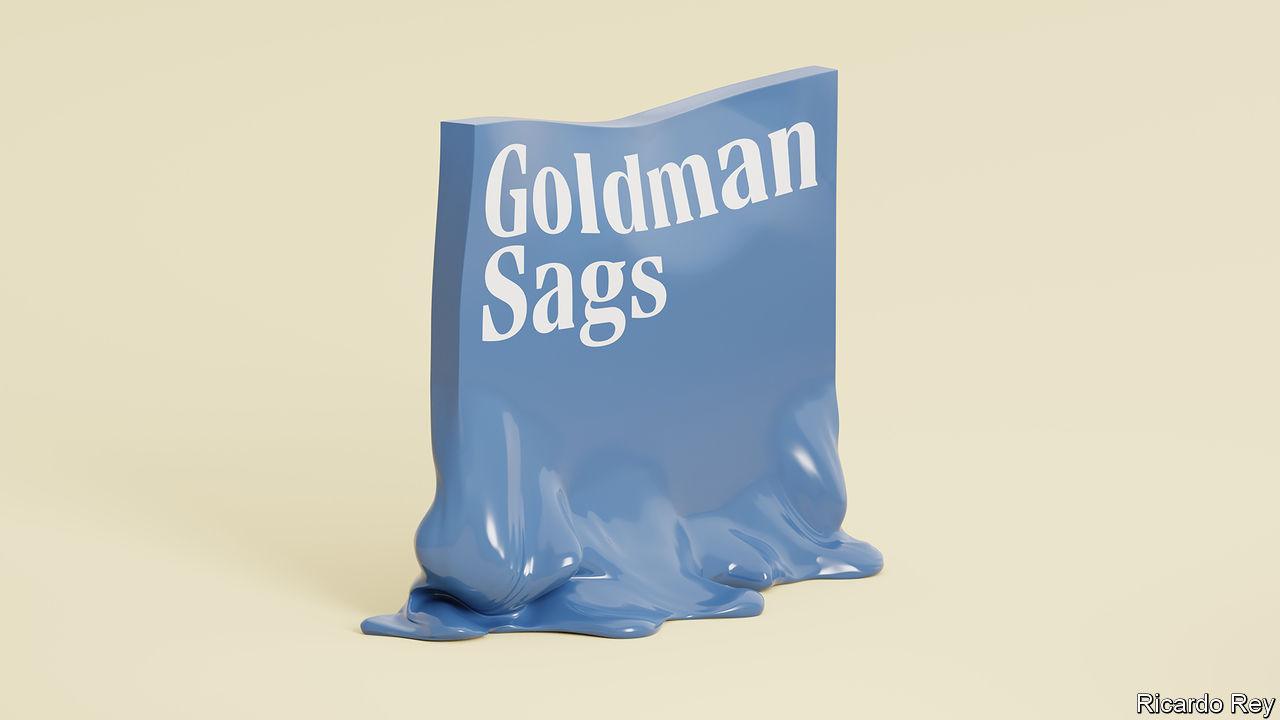
GOLDMAN SACHS has always seen itself as exceptional. When the bank floated its shares in New York in 1999 it declared: “We have an uncompromising determination to achieve excellence in everything we undertake.” Conspiracy theorists have long paid it the backhanded compliment of imagining that it secretly runs the world. Yet lately the only exceptional thing about the Wall Street icon has been its mistakes.

mythology
n. (统称)神话, 某文化(或社会等)的神话, 虚幻的想法, 错误的观点
determination
n. 坚定,果断;决心;决定
Conspiracy
n. 密谋策划, 阴谋
compliment
n. 致意,问候;赞美,称赞
v. 赞扬;称赞

高盛集团一直认为自己是与众不同的。1999年,当该银行在纽约上市时,它宣称:“我们有不妥协的决心,在我们所从事的每一件事上都要做到卓越。”长期以来,阴谋论者一直在暗中赞美它,想象它秘密地操纵着世界。然而,最近这家华尔街偶像唯一与众不同的地方就是它的错误。

Since October Goldman has made a U-turn on its plan to build a big consumer bank; booked one of its worst quarterly results for a decade, measured by return on equity; and attracted a probe by the Federal Reserve. The firm is not yet in serious trouble, but it is trapped by its own mythology. Its recent struggles show how hard it will be to reform—and illuminate a new balance of power in global finance.

equity
n. 公平, 公正, 资产净值, (公司的)股本
probe
v. 盘问,追问;探查,探测
n. 探究,详细调查;探针;探测器
Reserve
v. 保留,预订
n. 储备;储存物资;保护区
illuminate
v. 照明,照射;阐释,说明;用彩灯装饰;使精神焕发

自去年10月以来,高盛对其建立大型消费银行的计划做出了180度大转弯;以股本回报率衡量,该公司录得10年来最糟糕的季度业绩之一;并引起了美联储的调查。这家公司还没有陷入严重的困境,但它被自己的神话所困。它最近的挣扎表明了改革的难度,并阐明了全球金融领域的新力量平衡。

To understand Goldman today, take a walk down Wall Street. After the financial crisis of 2007-09, two big American banks reinvented themselves. JPMorgan Chase successfully pursued vast scale across a wide range of business lines. Morgan Stanley built a thriving arm managing the assets of the wealthy, which mints reliable profits. Goldman, however, stuck to its game of trading, advising on deals and bespoke investing. Penal new capital rules made this less lucrative, but the firm staked a Darwinian bet that the resulting shakeout would kill off many competitors. Instead, it badly underperformed the stockmarket for years and got ensnared in the 1MDB scandal, in which officials in Malaysia and Abu Dhabi received $1.6bn of bribes in 2009-14. A Goldman subsidiary pleaded guilty to a criminal charge and the firm admitted “institutional failure”.

bespoke
adj. 定做的
v. bespeak的过去式和过去分词
Penal
adj. 惩罚的, 刑罚的, 应受刑罚的, 严重的
n. 同“penal servitude. do penal”
lucrative
adj. 赚大钱的, 获利多的
underperform
v. 发挥不好, 表现不理想
scandal
n. 丑闻;丑行;关于丑行的传言

要了解今天的高盛,就去华尔街走一走。在2007-09年的金融危机之后,两家美国大银行进行了自我改造。摩根大通成功地在广泛的业务范围内实现了大规模扩张。摩根士丹利建立了一个繁荣的部门,管理富人的资产,创造可靠的利润。然而,高盛坚持自己的交易游戏,为交易提供建议和定制投资。惩罚性的新资本规定使得这种做法不那么有利可图,但该公司进行了达尔文式的打赌,认为由此产生的洗牌将杀死许多竞争对手。然而,该公司多年来表现严重逊于股市,并卷入1MDB丑闻。2009年至2014年,马来西亚和阿布扎比的官员收受了16亿美元贿赂。高盛的一家子公司承认了一项刑事指控,该公司承认“制度失败”。

The firm’s boss, David Solomon, took over in 2018. A man with a short fuse, he has tried to rebrand himself and to renew the firm by expanding its core and diversifying into new areas. Goldman now offers transaction banking to multinationals, helping them move funds globally. It has bulked up its asset- and wealth-management arm. And from their Manhattan skyscraper, flush Goldmanites dreamed of growing a mass-market digital bank for ordinary consumers, including a credit-card operation.

fuse
v. 结合,融合;(使)熔化
n. 保险丝;导火线;引信
skyscraper
n. 摩天大楼

该公司老板大卫·所罗门(David Solomon)于2018年上任。作为一个脾气暴躁的人,他试图重塑自己的形象,并通过扩大核心业务和向新领域多元化来重振公司。高盛现在为跨国公司提供交易银行业务,帮助它们在全球范围内转移资金。它已经壮大了资产和财富管理部门。在曼哈顿的摩天大楼里,高盛人梦想着为普通消费者发展一家面向大众市场的数字银行,包括信用卡业务。

Parts of Mr Solomon’s strategy have paid off. Goldman’s market share in mergers and bond trading has risen, helping it make a monster $21bn in profits in 2021 as markets boomed. From taxpayers’ viewpoint, it is safer, with more capital and deposits. And, importantly, its share price has recovered lost ground, rising more than the market and those of most of its peers.

bond
n. 联系,关系,(情感的)纽带;债券;结合
v. 结合,团结在一起
deposit
v. 放下, 放置; 存放, 寄存; 存钱; (使)沉淀, (使)沉积; 付, 预付
n. 存款; 押金, 订金; 堆积物, 沉积物; 矿床; 存储; 沉积

所罗门先生的部分策略取得了成效。高盛在并购和债券交易领域的市场份额有所上升,随着市场繁荣,帮助其在2021年实现了210亿美元的巨额利润。从纳税人的角度来看,它更安全,有更多的资金和存款。而且,重要的是,它的股价已经收复失地,涨幅超过了市场和大多数同行。

Yet look more closely and the project to remake the bank is vexingly incomplete. Diversification has been patchy: transaction-banking revenues are tiny and the asset-management arm is often dragged down by opaque proprietary bets. The dream of creating a consumer bank has soured. Goldman has 15m customers, but has also faced large losses and bad-debt charges, which is why it is now winding down part of the operation.

vexing
adj. 令人烦恼的
Diversification
n. 多样化, 【商】(投资的)分散经营
patchy
adj. 零散的, 散落的, 分布不匀的, 不完整的
drag
v. (使劲而吃力地)拖, 缓慢而费力地移动(或行进), 生拉硬拽
n. 令人厌烦的人, 乏味无聊的事, 累赘, 拖累
adj. 女穿男服的, 〈美俚〉男穿女服的
adv. 〈美俚〉带有女伴
proprietary
adj. 专卖的, 专营的, 专利的, 所有的
n. 所有权, 所有物, 所有团体
sour
adj. 酸的, 有酸味的, 酸腐的, 馊的
v. 恶化, 酸腐, 使变酸腐
n. 酸味, 痛苦, 讨厌的东西, 〈美〉酸味饮料

然而,更仔细地观察,重塑世界银行的项目是令人烦恼的不完整的。多元化经营并不完善:交易银行业务收入微薄,资产管理部门经常被不透明的自营投资拖累。创建一家消费者银行的梦想破灭了。高盛拥有1500万客户,但也面临着巨额亏损和坏账费用,这就是为什么它现在正在逐步缩减部分业务。

As the prospects for a big new earnings machine have receded, everything still rests on the traditional business. The profitability of the trading arm has improved but remains volatile and, on average, pedestrian. Overall, Goldman has made reasonable use of its resources, generating a return on tangible equity of 14% over Mr Solomon’s tenure. But its performance is erratic, veering from 33% in early 2021 to just 5% in the latest quarter. It has lagged behind its American peers half of the time, and the two industry leaders, JPMorgan and Morgan Stanley, two-thirds of the time. Investors think that Goldman is worth only the net book—or liquidation—value of its assets, suggesting they doubt that it can generate consistently high returns or find lucrative new areas.

recede
vi. 后退,减弱
vt. 撤回
volatile
adj. 易变的, 无定性的, 无常性的, 可能急剧波动的
pedestrian
n. 行人,步行者
adj. 行人的;缺乏想象力的,乏味的
tenure
n. 任期, (土地,资产等)保有权, 终身教席
erratic
adj. 不规则的, 不确定的, 不稳定的, 不可靠的
n. 漂砾, 漂石
veer
v. 改变, 突然变向, 猛然转向, 偏离
n. 方向的改变

由于新的大型盈利机器的前景已经消退,一切仍依赖于传统业务。交易部门的盈利能力有所改善,但仍不稳定,平均而言表现平平。总的来说,高盛合理地利用了其资源,在所罗门先生任期内创造了14%的有形资产回报率。但其表现不稳定,从2021年初的33%转向最近一个季度的5%。它有一半的时间落后于美国同行,有三分之二的时间落后于两大行业领导者摩根大通和摩根士丹利。投资者认为高盛只值其资产的账面净值或清算价值,这表明他们怀疑高盛能否持续产生高回报或找到有利可图的新领域。

Goldman’s struggles point to several lessons. One is that it still excels, but in a bad industry. Investment banking combines the drawbacks of a regulated activity (capital requirements and red tape) with the vices of a speculative one (volatility and capture by employees). The firm says it has become more disciplined on pay but last year forked out $15bn, its second-highest salary and bonus bill since the financial crisis, even as profits halved to $11bn and the firm barely beat its cost of capital. The real action in finance is outside regulated banking, where a new cohort of stars rules, including Blackstone in private markets, BlackRock in index funds, and Citadel, an investing and trading house that made its clients $16bn in 2022.

excel
v. 超过;擅长;突出
n. Excel电子表格(办公软件)
drawback
n. 缺点,弱点;不利条件
speculative
adj. 推测的, 猜测的, 推断的, 揣摩的
disciplined
adj. 遵守纪律的
halve
v. (使)减半;把…对半分
cohort
n. (有共同特点或举止类同的)一群人, 同伙, 支持者

高盛的困境指向了几个教训。其一,它仍然是优秀的,但在一个糟糕的行业。投资银行业既有受监管活动的缺点(资本要求和繁文缛节),也有投机活动的缺点(波动性和被员工俘获)。该公司表示,它在薪酬方面已变得更加自律,但去年支出了150亿美元,这是自金融危机以来第二高的薪酬和奖金支出,尽管该公司利润减半至110亿美元,且勉强低于其资本成本。金融业的真正行动在受监管的银行业之外,一群新的明星主宰着银行业,包括私募市场的黑石(Blackstone)、指数基金的贝莱德(BlackRock),以及投资和交易公司Citadel,该公司在2022年为其客户创造了160亿美元的利润。

Another lesson is that it is hard to compete in winner-takes-all digital markets. Goldman thought that brains and brand were enough. Not true. It has spent billions, but its customer base remains a fraction of that of PayPal or Amazon. JPMorgan reaches 66m American households, but maintains a vast physical network of branches. Goldman has achieved digital scale by teaming up with Apple to provide a credit card. However, given that the tech giant has almost a billion paying subscribers, Apple holds the whip hand in that relationship.

fraction
n. 一部分,小部分;碎片;些微,一点儿;分数;小数
whip
v. 鞭打, 鞭笞, 〈口〉击败, 抽打
n. 鞭子, 【无线】鞭状天线, 投票指示, (某党)议员领袖

另一个教训是,在“赢者通吃”的数字市场很难竞争。高盛认为头脑和品牌就足够了。不正确的。它已经花费了数十亿美元,但其客户基础仍只是贝宝(PayPal)或亚马逊(Amazon)的一小部分。摩根大通覆盖了6600万美国家庭,但仍保持着庞大的实体网点。高盛通过与苹果(Apple)合作提供信用卡,实现了数字化规模。然而,考虑到这家科技巨头拥有近10亿付费用户,苹果在这种关系中处于上风。

A final lesson is that the stagnation of globalisation has shrunk Wall Street’s horizons. In the decade after Goldman listed, international revenues provided half of its growth, as its bankers conquered Europe and then broke into Asia. Today they supply a third of growth, as local competitors have emerged and some countries have become wary of foreign financiers. The number-one arranger of shares and bonds last year in China was CITIC Securities; in India Kotak Mahindra and Axis led the pack. These are names that many on Wall Street may not know.

stagnation
n. 停滞, 滞止, 萧条, 迟钝

最后一个教训是,全球化的停滞缩小了华尔街的视野。在高盛上市后的十年里,随着其银行家征服欧洲,然后进军亚洲,国际收入为其贡献了一半的增长。如今,随着本土竞争对手的出现,以及一些国家对外国金融家变得谨慎起来,它们贡献了三分之一的增长。去年中国最大的股票和债券发行人是中信证券(CITIC Securities);在印度,Kotak Mahindra和Axis领先。许多华尔街人士可能并不知道这些名字。

Raging bulls
Can Goldman recover its swagger? Mr Solomon is wisely laying off staff and shrinking the bank’s proprietary investments. Over time he may be vindicated by prosaic changes—running its asset-management arm better, say, or pioneering new tech to cut exorbitant labour costs—or even by orchestrating a merger.

swagger
v. 神气十足地走,大摇大摆地走
n. 大摇大摆,神气十足
adj. 〈口〉漂亮的
proprietary
adj. 专卖的, 专营的, 专利的, 所有的
n. 所有权, 所有物, 所有团体
prosaic
adj. 平庸的, 没有诗意(或美感)的, 平淡的, 乏味的
exorbitant
adj. 过高的, 高得离谱的
orchestrate
v. 精心安排, 编配(或创作)管弦乐曲, 策划, 密谋

高盛还能重振雄风吗?所罗门先生正在明智地裁员并缩减银行的自营投资。随着时间的推移,他可能会通过一些平淡无奇的改变——比如更好地运营资产管理部门,或者开拓新技术以削减过高的劳动力成本——甚至通过策划一次合并来证明自己的正确。

Yet there is something uniquely hard about reforming elite firms whose unwritten code is that they are smarter than everyone else. Just ask McKinsey, a scandal-magnet once known as the world’s most-admired consultancy. Goldman’s culture of self-regard remains at odds with the facts. Instead it now needs to be self-critical. For yesterday’s masters of the universe, that may be the hardest leap of all. ■

然而,对于那些不成文的准则是他们比其他人都聪明的精英公司来说,改革是一件特别困难的事情。问问麦肯锡(McKinsey)就知道了,这家丑闻不断的公司曾被誉为全球最受尊敬的咨询公司。高盛自重的文化仍与事实不符。相反,它现在需要自我批评。对于昔日的宇宙主宰来说,这可能是最艰难的一步。■

1052 words

Growing pains

发表于 2023-02-27 | 分类于 The Economist

The painful development of India’s startups
Time and money are running out
Investors lose faith in India’s unicorns
Jan 19th 2023 | BANGALORE

“HOW LONG is your runway before takeoff?” That is how venture capitalists (VCs) begin meetings in India these days, says Ananth Narayanan, founder of Mensa, one of the country’s newest unicorns (companies worth in excess of $1bn). Until recently the main question that mattered for India’s startup scene was valuation. But the mood has changed. Plunging share prices at companies that have gone public have made VC firms much warier about investing. Prizing unrealistic valuations has given way to worrying about how quickly startups might begin to make money. So far Mensa, which buys stakes in digital brands, is one of a handful of such firms that makes a profit.

takeoff
n. 起飞
scene
n. 现场, 景象, 情景, 景色,事件
valuation
n. 评估, 评价, 估值, (专业)估价
Plunge
v. (使)突然向前倒下[跌落];价格、比率等〕暴跌,骤降;〔船〕猛烈地颠簸
n. 突降;俯冲;〔价格、价值等的〕骤降;突然卷入;跳水;〔短时间的〕游泳
Prize
n. 奖, 奖品, 奖金, 奖赏
adj. 好得足以得奖的, 应获奖的, 优秀的, 典范性的
v. 珍视, 高度重视

“起飞前的跑道有多长?”印度最新的独角兽公司(市值超过10亿美元的公司)之一门萨(Mensa)的创始人Ananth Narayanan说,这就是风投们最近在印度开会的方式。直到最近,对印度初创企业来说最重要的问题还是估值。但人们的情绪已经发生了变化。上市公司股价的暴跌使得风投公司在投资时更加谨慎。对不切实际的估值的重视已经让位于对初创公司可能多快开始赚钱的担忧。到目前为止,门萨(Mensa)是为数不多的几家盈利公司之一,该公司收购了数字品牌的股份。

That leaves plenty that do not. Since the beginning of 2021, the number of unicorns created in India has risen from 40 to 108. Only America and China have produced more. In 2021 promising startups had no trouble finding investors eager to fund fast-growing firms with big ideas. That year investment in startups tripled to $35bn. The momentum continued in 2022, with $3.7bn invested in March alone. Such was the clamour that startups had their pick of “founder friendly” investors who were not too bothered about supervision, the drudgery of background checks and other intrusive oversight.

momentum
n. 动量, 势头, 动力, 推进力
clamour
n. 吵闹, 喧闹声, 嘈杂声, 民众的要求
v. 大声(或吵闹)地要求, (尤指乱哄哄地)大声地喊叫
drudgery
n. 单调乏味的苦差事, 繁重无聊的工作
intrusive
adj. 侵入的, 闯入的, 侵扰的, 烦扰的
oversight
n. 监督,照管;疏忽, 失察, 忽略, 负责

还有很多公司没有。自2021年初以来,印度独角兽公司的数量从40家增加到108家。只有美国和中国的产量更高。2021年,有前途的初创公司毫不费力地找到了渴望为有大想法的快速增长的公司提供资金的投资者。那一年,创业公司获得的投资增加了两倍,达到350亿美元。这一势头在2022年继续保持,仅3月份就有37亿美元的投资。创业公司有他们自己选择的“对创始人友好”的投资者,这些投资者不太担心监管、背景调查的苦差事和其他侵入性的监管。

The environment has since cooled. Investment in December was only $900m. One reason is the woeful performance of firms that went public in 2021: Zomato (food delivery), Freshworks (enterprise software), Paytm (payments), Policy Bazaar (insurance) and Nykaa (fashion). The share prices of each has tumbled in excess of 59%. And while a global rout in tech valuations has coincided with a broader sell-off, that is not true of India. The Sensex, an index of the country’s biggest 30 firms, is close to an all-time high and the economy is growing at a decent clip.

woeful
adj. 糟糕的, 严重的, 不合意的, 悲惨的
tumble
v. 跌倒, 摔倒, 倒塌, 绊倒,垮台
n. 摔倒, 跌跤; 骤降; 混乱的一团
decent
adj. 得体的; 适当的; 体面的; 正派的; 过得去的, 尚可的, 还好的; 合乎地位的, 像样的

环境已经冷却下来。去年12月的投资仅为9亿美元。其中一个原因是2021年上市的公司表现糟糕:Zomato(送餐)、Freshworks(企业软件)、Paytm(支付)、Policy Bazaar(保险)和Nykaa(时尚)。这两家公司的股价跌幅都超过了59%。尽管全球科技股估值暴跌与更广泛的抛售同时发生,但印度的情况并非如此。由印度最大的30家公司组成的Sensex指数接近历史最高水平,印度经济正以相当快的速度增长。

The poor performance means that other planned listings, such as that of PharmEasy, an online pharmacy, will not now go ahead. Acquisitions have been similarly hit. In October the $4.7bn purchase of BillDesk by PayU, both profitable payments companies, was cancelled. PayU’s owner Prosus, a local VC firm affiliated to Naspers, a Dutch-South African company, is widely believed to have walked away because the fall in Paytm’s share price created a new, and far lower, benchmark for what a payments company is worth.

pharmacy
n. 药房, 药店, 药剂学, 医药柜台
Acquisition
n. (技能、习惯或品质的)习得, 培养; (一家公司对另一家公司的) 收购; 资产获得, 获得物
benchmark
n. 基准, 水准点, 标准检查程序, 水准标
v. 用基准问题测试

这种糟糕的表现意味着,其他计划中的上市,如在线药店PharmEasy的上市,现在将无法进行。收购也受到了类似的打击。去年10月,PayU以47亿美元收购BillDesk的交易被取消,这两家公司都是盈利的支付公司。PayU的所有者Prosus是一家荷兰-南非合资公司Naspers旗下的当地风投公司,外界普遍认为,该公司之所以退出Paytm,是因为Paytm股价的下跌创造了一个新的、低得多的支付公司价值基准。

Re-evaluating what startups might be worth is now the foremost concern of all India’s VC firms. Funding hinges on assessing reserves, costs and the time needed to become profitable. In theory, this sort of information is available for all Indian firms because they are required to file public financial statements. But the system operates poorly. Of the 40 startups that have filed results for 2022 only three are profitable, according to Tracxn, a statistical service, and based on their annual spending, only five have enough cash to survive for over six months (see charts).

hinge
n. 铰链,合叶
v. 给…装上铰链

重新评估创业公司的价值是所有印度风投公司最关心的问题。融资取决于对储量、成本和盈利所需时间的评估。从理论上讲,所有印度公司都可以获得这类信息,因为他们被要求提交公开的财务报表。但是这个系统运行得很糟糕。根据统计服务公司Tracxn的数据,在提交了2022年业绩报告的40家初创公司中,只有3家是盈利的,根据它们的年度支出,只有5家有足够的现金生存6个月以上(见图表)。

In response to the tougher environment, costs are being cut. Inc42, an online publication tracking startups, counts 20,500 layoffs over the past year, probably foreshadowing a much bigger wave. Edtech has been especially hard hit, with 16 companies axing over 8,000 employees, the most coming at Byju, India’s most valuable startup, which is sacking 2,500 employees. A post-lockdown return to classrooms and low barriers to creating educational material online has raised doubts about the entire sector’s prospects.

layoff
n. 临时解雇, 操作停止, 活动停止期间
foreshadow
v. 预示, 是…的预兆

为了应对更加严峻的环境,企业正在削减成本。追踪创业公司的在线出版物Inc42统计,去年有20500人被裁员,这可能预示着一波更大的裁员潮。教育科技公司受到的打击尤其严重,有16家公司裁员超过8000人,其中印度最有价值的初创公司Byju裁员最多,裁员2500人。封锁后重返课堂,在线制作教育材料的门槛较低,这让人们对整个行业的前景产生了怀疑。

Byju has other problems. It was accused in July of inappropriately aggressive accounting and sales policies, which it denies. Other startups have also come under fire. BharatPe (payments), Trell (social media) and Zilingo (supply-chain management) saw founders quit last year after fraud accusations. BharatPe’s founder denies the allegations as does Trell; Zilingo is investigating the claims. On January 18th Amit Bhasin, a co-founder of GoMechanic, a car-repair firm, admitted to “errors in judgment as we followed growth at all costs, particularly in regard to financial reporting, which we deeply regret” after it cut 70% of its workers.

aggressive
adj. 侵略性的;好斗的;有进取心的;有闯劲的;激进的
fraud
n. 骗子, 欺诈罪, 欺骗罪, 行骗的人
accusation
n. 控告, 起诉, 告发, 谴责
allegation
n. 断言, 宣称; 主张; 辩解; 指控

Byju还有其他问题。今年7月,该公司被指控采取不恰当的激进会计和销售政策,但该公司对此予以否认。其他创业公司也受到了抨击。去年,BharatPe(支付)、Trell(社交媒体)和Zilingo(供应链管理)的创始人因欺诈指控而辞职。BharatPe的创始人和特雷尔都否认了这些指控;Zilingo正在调查这些说法。1月18日,汽车维修公司GoMechanic的联合创始人Amit Bhasin在公司裁员70%后承认“我们在不惜一切代价追求增长的过程中做出了错误的判断,特别是在财务报告方面,对此我们深感遗憾”。

These tribulations have brought the role of backers into question. Were firms sufficiently monitored? Were valuations credible? Sequoia Capital, a prominent Silicon Valley firm, has invested in GoMechanic, BahratPe, Trell, Zilingo and several edtech companies. It acknowledged in April the governance issues in various holdings and vowed to provide stricter oversight but has declined to comment further. Other foreign VC firms are rethinking how they approach India, too. A more diligent approach may be required.

tribulation
n. 苦难, 磨难, 忧患, 痛苦
sufficiently
adv. 足以, 十分, 充分地, 最大限度地
diligent
adj. 孜孜不倦的, 勤勉的, 刻苦的

这些磨难让投资者的角色受到了质疑。企业是否得到了充分的监控?估值可信吗?硅谷著名公司红杉资本(Sequoia Capital)已经投资了GoMechanic、BahratPe、Trell、Zilingo和几家教育科技公司。今年4月,该公司承认多家控股公司存在治理问题,并誓言将提供更严格的监督,但拒绝进一步置评。其他外国风投公司也在重新考虑如何进入印度市场。可能需要一种更勤奋的方法。

How companies come to market is also set to change in response to the losses from public offerings. India’s stockmarket regulator made changes in September that will enable far greater scrutiny. It will force firms to provide information on the prices of private transactions that occurred before listings, as well as the key data used to derive valuations. Large investors will also be required to hold at least half of their shares through at least one accounting period to stop them selling shares during a spell of hype after an offering.

scrutiny
n. 仔细检查; 认真彻底的审查; 监视, 监督
transaction
n. 交易,生意;处理,办理
spell
v. 用字母拼,拼写,拼出,拼作;招致;暂时代替;稍事休息;导致
n. (持续的)一段时间, (干某事或在某处工作的)一段时间, 咒语, 符咒, 魅力
hype
n. (电视、广播等中言过其实的)促销广告
v. 夸张地宣传(某事物)

公司上市方式也将改变,以应对公开发行的亏损。印度股市监管机构在9月份进行了改革,这将使更严格的审查成为可能。它将迫使公司提供上市前私人交易的价格信息,以及用于得出估值的关键数据。大型投资者还将被要求在至少一个会计期间持有至少一半的股票,以防止他们在新股发行后的炒作期出售股票。

These changes may not head off the carnage to come. Anand Lunia of India Quotient, a VC firm in Bangalore, believes a quarter to half of the current unicorns will become zombie firms that will exist in name but cease to be funded or operate. His willingness to speak openly is unusual; his views are not. Yet for all the concerns about the immediate future, neither Mr Lunia nor many others who think sharp devaluations are coming are pessimistic about the long-term for startups. The economy is growing strongly and India is good at nurturing entrepreneurial software engineers whose skills increasingly apply in every industry. All of this suggests that the storm ahead will be followed by a resumption of growth, eventually.■

head off
phrase. 上前拦住 (使退回或转变方向),拦截
phrase. 转移…的思想 (或注意力);阻止,防止…发生
carnage
n. 大屠杀
zombie
n. 僵尸, 怪人
sharp
adj. 锋利的, 锐利的, 尖的, (变化)急剧的, (语言)尖刻的
adv. (用于表时间的词语后,表示准时)…整, 向左╱向右急转, 偏高音地
n. 升号, 锐利的东西(如针、注射器等)
v. 磨, 诈欺, 磨利, 磨快
pessimistic
adj. 悲观的, 悲观主义的
nurture
v. 培养, 养育, 养护, 支持
n. 培养, 养育
entrepreneurial
adj. 创业, 企业家的
resumption
n. 恢复, 重新开始, 继续进行

这些变化可能无法阻止即将到来的大屠杀。班加罗尔风投公司India Quotient的Anand Lunia认为,目前四分之一到一半的独角兽公司将变成僵尸公司,名存实亡,但停止融资或运营。他愿意公开发言是不同寻常的;但他的观点并非如此。然而,尽管人们对近期的未来感到担忧,但无论是卢尼亚还是其他许多认为货币将大幅贬值的人,都对初创企业的长期发展持悲观态度。印度经济增长强劲,擅长培养具有创业精神的软件工程师,这些工程师的技能越来越适用于各个行业。所有这些都表明,在风暴过后,经济最终将恢复增长。■

940 words

123

REQg

25 日志
3 分类
© 2023 REQg
由 Hexo 强力驱动
|
主题 — NexT.Mist v5.1.4
浙ICP备 - 19004121号